

Taxes in Serbia (2026): A Practical Guide for Foreigners and Foreign Companies

Foreigners pay taxes in Serbia on the same terms as Serbian citizens. What decides is tax residency, not nationality: a tax resident pays Serbian tax on worldwide income, a non-resident only on income from Serbia. Income tax rates are low by European standards, 10% on salaries and 15% on company profits, but social security contributions of 35.05% on salaries change the picture, and most of the costly mistakes I see are about timing and paperwork, not rates.
This guide covers taxation in Serbia for both audiences: individuals who move here or earn income here, and foreign companies that set up or do business here. Each section gives the rule and the 2026 numbers, with a link to my detailed guide where there is one. Figures are for 2026 unless stated otherwise. Last reviewed: November 2026.
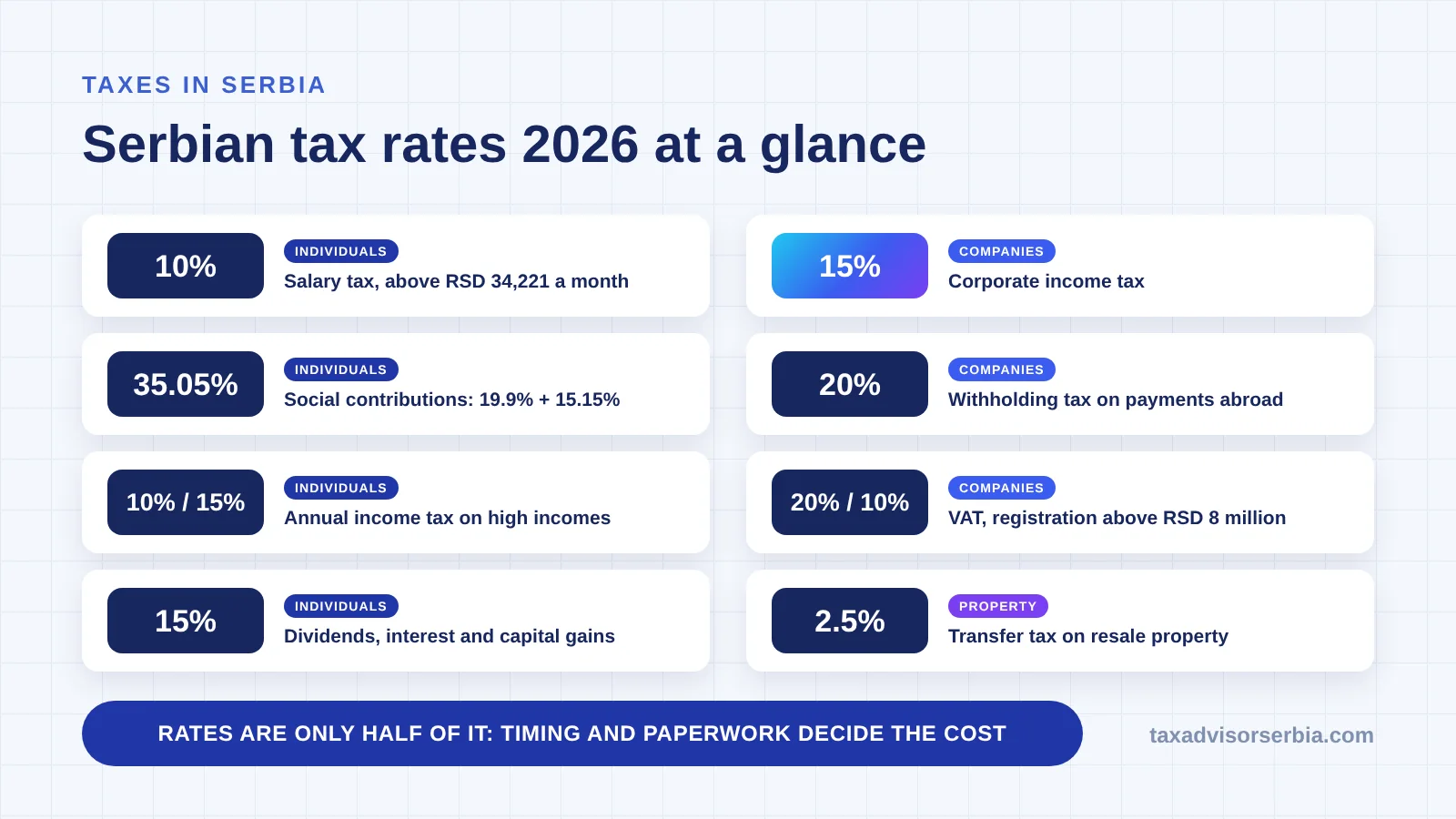
Serbian tax rates in 2026 at a glance
Individuals
- Salary tax: 10% of gross salary above a monthly non-taxable amount of RSD 34,221.
- Social security contributions: 19.9% paid by the employee and 15.15% by the employer, 35.05% in total, on a monthly base between RSD 51,297 and RSD 732,820.
- Annual personal income tax: 10% and 15%, only on income above RSD 5,439,096 a year (2025 income, filed in 2026).
- Dividends, interest and capital gains: 15%.
- Rental income: 20% of the rent after 25% standardised costs, an effective 15%.
- Freelancers paid from abroad: quarterly self-assessment, at 20% after standardised costs of RSD 110,647 a quarter, or 10% after RSD 66,733 plus 34% of income, with contributions on top.
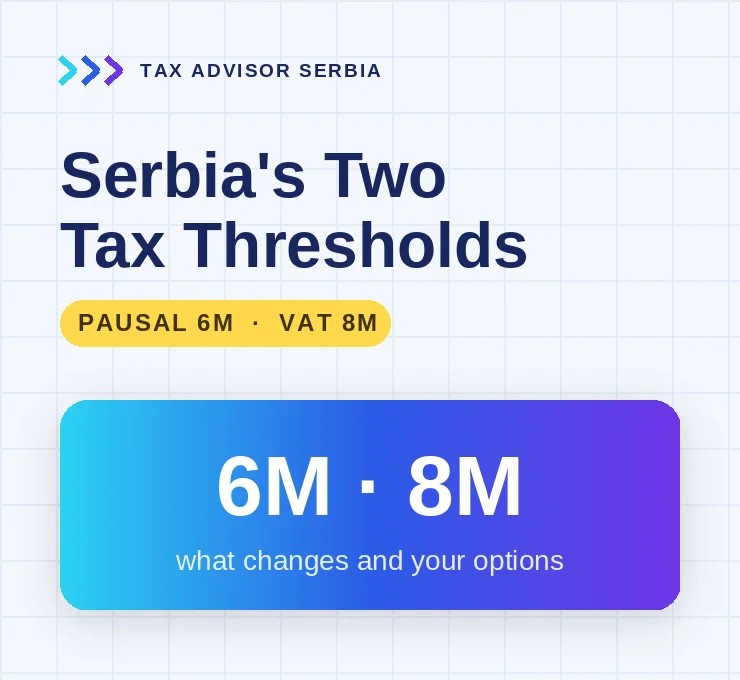
- Flat-rate entrepreneurs (paušal): fixed monthly tax and contributions, up to RSD 6 million of turnover a year.
Companies
- Corporate income tax: 15%.
- Withholding tax on dividends, interest, royalties, rent and certain services paid to foreign companies: 20%, or 25% for recipients in preferential tax jurisdictions (dividends excluded), unless a tax treaty reduces it.
- VAT: 20% standard rate and 10% reduced rate. Registration is mandatory above RSD 8 million of turnover in the previous 12 months.
Property
- Transfer tax on resale property: 2.5%.
- Annual property tax: set by each municipality within legal maximums: up to 0.4% for companies, and for individuals progressive rates of up to 2% on the part of the value above RSD 50 million.
- Inheritance and gift tax: none for children and the spouse, 1.5% for second-order heirs, 2.5% for everyone else.
How taxation in Serbia works
Taxation in Serbia is schedular. There is no single return that adds up everything a person earns: each type of income (salary, business income, rent, dividends, capital gains and others) is taxed separately, at its own rate, mostly at the moment it is paid. The payer calculates, withholds and pays the tax, so most employees in Serbia never file a tax return.
Two things sit on top of that. First, people with high income pay an annual personal income tax by 15 May of the following year. Unlike in many countries, it is not a reconciliation of the taxes paid during the year but an additional tax on income above a threshold. Second, when nobody in Serbia withholds the tax, for example when a resident is paid from abroad, the individual has to report and pay it.
The tax year is the calendar year. The Tax Administration (Poreska uprava) collects national taxes and runs the ePorezi portal for electronic filing, which works only in Serbian. Municipalities assess and collect property tax. Taxes are paid in dinars (RSD).
The main laws are the Law on Personal Income Tax, the Law on Contributions for Mandatory Social Insurance, the Law on Corporate Income Tax, the Law on Value Added Tax, the Law on Property Taxes and the Law on Tax Procedure and Tax Administration.
Do foreigners pay tax in Serbia? Tax residency
Yes, if they are tax residents or earn income from Serbia. Under Article 7 of the Law on Personal Income Tax, you are a Serbian tax resident if you meet any one of three tests:
- you have a registered domicile (prebivalište) in Serbia;
- your centre of business and vital interests is in Serbia; or
- you spend 183 days or more in Serbia within any 12-month period that begins or ends in the tax year.
Residents are taxed on their worldwide income, non-residents only on income from Serbian sources.
Days do not need to be consecutive, and part of a day counts as a full day, except time in transit. If you already know when you first arrive that you will meet a test, for example because you come on an indefinite local employment contract, you are resident from day one, not from day 183. The years of arrival and departure are split, so the part of the year before you arrive is not taxed as resident.
A residence permit is an immigration status, not a tax test. The two often go together, because permit holders usually spend more than 183 days a year in Serbia, but residency for tax purposes is decided by the three tests above.
If another country also treats you as resident, the tax treaty between the two countries, where one exists, decides through tie-breaker rules applied in order: permanent home, centre of vital interests, habitual abode, nationality. Residency in the other country is proven only with a certificate issued by that country. In Serbia, the Tax Administration issues a certificate of residence (POR-1) within 8 days of a complete request.
Non-residents have one domestic safe harbour: the income of a non-resident who spends up to 90 days in Serbia within 12 months is exempt if it comes from a foreign principal that does not do business in Serbia (Article 9b).
My guide to Serbian tax residency covers the vital interests test, the evidence the Tax Administration looks for and the certificate in detail.

Tax on salary in Serbia
An employer in Serbia calculates, withholds and pays salary tax and contributions every time it pays a salary. In 2026:
- Salary tax is 10% of gross salary minus the non-taxable amount of RSD 34,221 a month.
- Employee contributions are 19.9% of gross salary: pension and disability insurance 14%, health insurance 5.15% and unemployment insurance 0.75%.
- Employer contributions are 15.15% on top of gross salary: pension and disability insurance 10% and health insurance 5.15%.
- Contribution bases: contributions are charged on at least RSD 51,297 and at most RSD 732,820 of salary a month.
Worked example: gross salary of RSD 200,000 a month in 2026
- Employee contributions: 19.9% of RSD 200,000 = RSD 39,800
- Salary tax: 10% of (RSD 200,000 minus RSD 34,221) = RSD 16,578
- Net salary: RSD 143,622
- Employer contributions: 15.15% of RSD 200,000 = RSD 30,300
- Total cost to the employer: RSD 230,300
The employee keeps about 72% of the gross salary, and every RSD 100 of net salary costs the employer about RSD 160. My net salary calculator runs the same calculation for any amount.
Benefits in kind, such as private use of a company car or a flat provided by the employer, are taxed as salary. Some reimbursements, such as commuting costs and business travel allowances, are tax-free up to limits set each year.
Working for a foreign employer from Serbia. Salary in the Serbian tax sense exists only with a Serbian employer. If you live in Serbia and work remotely for a foreign employer, your pay is taxed as freelancer income: you report it every quarter and pay the tax and contributions yourself, as explained in the section on regimes below. The employer should also check whether your work here creates a permanent establishment for it in Serbia.
Social security agreements. If your home country has a social security agreement with Serbia, you may stay in your home system with a certificate of coverage instead of paying Serbian contributions. The United States has no such agreement with Serbia.
The newly settled taxpayer incentive
The main tax incentive for people who move to Serbia is the relief for newly settled taxpayers under Article 15v of the Law on Personal Income Tax. For five years, the salary tax base and the contribution base are reduced by 70%, so tax and contributions are charged on 30% of the base.
Two groups qualify:
- Category A: you did not predominantly stay in Serbia in the 24 months before signing the Serbian employment contract, and your monthly gross salary is above RSD 439,692 in 2026.
- Category B: you are under 40 when you sign, in the previous 12 months you were predominantly outside Serbia for education or professional development, and your monthly gross salary is above RSD 293,128 in 2026.
Both categories have day-count limits in the look-back period. You have to actually settle in Serbia and become tax resident through your centre of vital interests. The employment must be open-ended, with a Serbian resident employer that is not related to your previous employer. The relief starts with the salary for the month in which the proof of eligibility is obtained and cannot be applied to salaries already paid, so this is the step to get right before the first payroll, not after.
Worked example: Category A, gross salary of RSD 500,000 a month in 2026
- Contribution base: 30% of RSD 500,000 = RSD 150,000
- Employee contributions: 19.9% of RSD 150,000 = RSD 29,850
- Salary tax: 10% of 30% of (RSD 500,000 minus RSD 34,221) = RSD 13,973
- Net salary: RSD 456,177, against RSD 353,922 without the relief
- Employer contributions: 15.15% of RSD 150,000 = RSD 22,725, against RSD 75,750 without the relief
The salary thresholds rise every year, and the salary has to be above the threshold from the start. My guide to the newly settled taxpayer incentive explains the conditions, and the eligibility check tests a specific case.
Freelancer, paušal, entrepreneur or company: which regime fits
Foreigners who live in Serbia and work for foreign clients or employers can receive that income in four ways:
- Freelancer self-assessment. No company and no registration as an entrepreneur. You report each quarter on form PP OPO-K, within 30 days after the quarter ends (30 April, 30 July, 30 October and 30 January). In Model 1, the 2026 standardised costs are RSD 110,647 a quarter and the tax is 20%; in Model 2, they are RSD 66,733 plus 34% of income and the tax is 10%. You can switch models every quarter. Pension contributions of 24% and, unless you are insured on another basis, health contributions of 10.3% come on top.
- Flat-rate entrepreneur (paušalac). A fixed monthly amount of tax and contributions, set by the Tax Administration regardless of actual income, up to RSD 6 million of turnover in a calendar year.
- Entrepreneur keeping books (knjigaš). With the personal salary option under Article 33a, contributions are paid only on the personal salary, usually at the minimum base, and the remaining profit is taxed at 10%. The election (form OLZ) is filed by 15 December for the following year.
- Limited liability company (DOO). 15% corporate income tax on profit and 15% tax on dividends paid to you, plus payroll taxes on any salary.
Two thresholds apply to entrepreneurs. The paušal limit is RSD 6 million of invoiced turnover per calendar year. The VAT threshold is RSD 8 million of taxable turnover in any rolling 12-month period; services to foreign business clients do not count toward it. My guide to the RSD 6 million and 8 million thresholds shows what happens at each. From 1 January 2027, an entrepreneur who loses paušal status gets 15 days to opt for the personal salary, instead of paying tax and contributions on the entire profit until 31 December.
Entrepreneurs who work mostly for one client also face the independence test under Article 85: nine criteria that describe an employment-like relationship. If five are met, the income from that client is taxed as other income, on the gross fee with no deduction for costs: 20% tax plus 24% pension contributions, roughly 44%, on top of what was already paid under the entrepreneur regime.
Which form costs least depends on income, costs and plans. As a rough guide from my comparison of the four tax models for foreign income:
- Up to RSD 6 million a year, paušal is usually the cheapest, provided the independence test is passed.
- Above that, an entrepreneur keeping books with the personal salary is usually more efficient. At RSD 8 million a year, a freelancer pays roughly twice the tax and contributions of an entrepreneur keeping books.
- A DOO costs more on profit you take out, because profit is taxed twice, but it fits when you hire people, reinvest profit or need limited liability.
The freelancer tax guide explains the quarterly return and both models step by step.
Annual personal income tax for higher earners
The annual tax applies when your income for the year exceeds three times the average annual salary in Serbia: RSD 5,439,096 for 2025 income. Residents count worldwide income, non-residents only income from Serbia.
- What counts: salary, self-employment income (paušal and bookkeeping entrepreneurs), author fees, freelancer and other income, rent from real estate and movable property, and short-term rental income, including the same types of income earned abroad. Each counts net of the tax paid on it in Serbia, and salary, freelancer, author and bookkeeping income also net of contributions.
- What does not count: dividends, interest, capital gains, winnings and insurance proceeds, which are taxed separately.
- Personal deductions: 40% of the average annual salary for you (RSD 725,213 for 2025) and 15% for each dependant (RSD 271,955), together capped at 50% of taxable income.
- Rates: 10% on taxable income up to six times the average annual salary (RSD 10,878,192 for 2025) and 15% above that.
- Under 40: if you are younger than 40 on 31 December, your salary, self-employment and author income are reduced by a further three average annual salaries, RSD 5,439,096 for 2025.
- Filing: form PP-GPDG, filed electronically, with the tax paid by 15 May of the following year.
Worked example: annual tax for 2025 income
You were 45 on 31 December 2025, have no dependants and earned a salary of RSD 9,000,000 after salary tax and contributions.
- Income above the threshold: RSD 9,000,000 minus RSD 5,439,096 = RSD 3,560,904
- Minus the personal deduction of RSD 725,213: taxable income RSD 2,835,691
- Annual tax at 10%: RSD 283,569, filed and paid by 15 May 2026
Had you been under 40 on 31 December 2025, the additional reduction of RSD 5,439,096 would have removed the annual tax in this example entirely.
The amounts for 2026 income are published early in 2027, once the 2026 average salary is known. My guide to the annual personal income tax explains each step, and the annual income tax calculator does the arithmetic.
Dividends, interest, capital gains and crypto
- Dividends and interest from Serbia: 15%, withheld by the paying company or bank. Dividend tax is final: dividends do not enter the annual tax. Interest on dinar deposits and on Serbian government bonds is exempt.
- Capital gains: 15% on gains from selling real estate, company shares, securities, digital assets and intellectual property. You report the gain yourself on form PPDG-3R, and a return is due even when you make a loss. The deadline is 30 days from receiving the price for real estate or a company share, 30 days after the end of each half-year for securities, and 120 days after the end of the quarter for digital assets.
- Exempt disposals: property, shares and securities you have owned continuously for at least ten years; transfers between spouses or between parents and children; and the sale of real estate when you invest the proceeds in your own housing in Serbia within 90 days (within 12 months, the tax paid is refunded).
- Income from abroad: a resident who receives dividends, interest or other income from abroad reports and pays the Serbian tax within 30 days of receipt, with a credit for the foreign tax paid, capped at the Serbian tax on the same income. The credit needs official proof of the foreign tax.
- Non-residents: dividends from Serbia paid to a foreign individual are taxed at 15% and to a foreign company at 20%, unless a treaty gives a lower rate and the residency certificate is in place before the payment.
My guide to dividend tax in Serbia covers payments to resident and foreign shareholders.
Property taxes: buying, owning, renting and selling
Buying. The sale of a resale property carries a 2.5% transfer tax on the contract price, or on the market value if that is higher. By law the seller is the taxpayer, but the contract can shift the cost to the buyer. The return is due within 30 days of the contract. A new apartment bought from the developer carries 10% VAT, included in the price, instead of transfer tax. A foreign buyer needs a Serbian tax number for the transfer and for property tax: my guide on getting a tax identification number in Serbia shows how.
Owning. The municipality assesses annual property tax on the usable floor area multiplied by the average price per square metre in the zone, at a rate it sets within legal maximums. Companies and entrepreneurs keeping books pay up to 0.4%, file the return by 31 March and pay quarterly. For individuals the maximum rate rises with value: up to 0.4% on the first RSD 10 million, up to 0.6% on the part between RSD 10 and 25 million, up to 1% between RSD 25 and 50 million and up to 2% above that. Individuals file a return within 30 days of acquiring the property and then receive a decision from the municipality. Property tax is paid in four quarterly instalments, each due within 45 days of the start of the quarter.
Renting. Rent from long-term letting is taxed at 20% after standardised costs of 25%, an effective 15% of the rent. If the tenant is a company or an entrepreneur, the tenant withholds the tax; if the tenant is an individual, you report and pay it yourself within 30 days of receiving the rent. Short-term rental of up to 30 days in registered private accommodation is taxed differently: on a flat amount per bed, set by law from the average salary and the category of the tourist location. Both count towards the annual tax.
Selling. An individual pays 15% capital gains tax on the gain. A foreign company selling Serbian real estate pays 20%, filed on form PP KDZN within 30 days through a tax representative, unless a treaty provides otherwise.
Inheritance and gifts. Children and other first-order heirs and the spouse are exempt, and so are the parents of the deceased for an inheritance. Second-order heirs and recipients pay 1.5% of the market value, and everyone else, including unrelated persons, 2.5%. The tax covers real estate, cash, bank deposits, digital assets, intellectual property rights and used vehicles, and the return is due within 30 days.
Taxes for foreign companies in Serbia
A Serbian subsidiary, usually a limited liability company (DOO), pays the same taxes as any Serbian company. A foreign company without a Serbian entity meets Serbian tax mainly through withholding tax, VAT and the permanent establishment rules. Registration itself is quick: my guides to company registration in Serbia and doing business in Serbia cover the setup.
Corporate income tax. Serbia taxes company profits at a flat 15%, and resident companies are taxed on worldwide income. Companies pay monthly advances by the 15th, based on the previous year's return, and file the annual return (PDP) with the tax balance within 180 days of the year end. For a calendar year that is 29 June, or 28 June in a leap year, moved to the next working day when it falls on a weekend or holiday. Tax losses can be carried forward for five years, without carry-back. Interest on related-party loans is deductible only up to four times the company's equity. Fines are never deductible, and donations and entertainment are deductible only up to caps of 5% and 0.5% of revenue.
Incentives. The main incentives are a double deduction of research and development costs and the IP box, which excludes 80% of qualifying income from a deposited copyright work, for an effective rate of 3%. The 10-year exemption for investments of at least RSD 1 billion with 100 new employees is being phased out: it is deleted from 1 January 2028, and only companies that meet the conditions by 31 December 2027 keep it. My guides to corporate income tax, non-deductible expenses and the IP box go into detail.
Withholding tax on payments abroad. A Serbian company that pays a foreign company withholds 20% tax on:
- dividends and other profit shares;
- interest;
- royalties;
- rent for real estate and movable property in Serbia;
- fees for market research, accounting, audit and other legal and business consulting services, wherever they are performed.
When the recipient is in a jurisdiction with a preferential tax system on the Ministry of Finance's list, royalties, interest, rent and fees for any services bear 25%, while dividends stay at 20%. The payer files the return (PDPO/S) and pays the tax within three days of the payment. A treaty rate applies only if the payer holds the recipient's tax residency certificate, on the prescribed form, before the payment. There is no tax treaty with the United States, so payments to US companies bear the full 20%. My withholding tax page covers treaty relief and refunds.
VAT. The standard VAT rate is 20% and the reduced rate 10%. Registration is mandatory once turnover exceeds RSD 8 million in the previous 12 months, and the registration has to be filed within five days of crossing the threshold. Below it, registration is voluntary. Returns are filed quarterly, or monthly once turnover in the previous 12 months exceeds RSD 50 million, with payment within 15 days after the period, and e-invoicing through the SEF system is mandatory for all VAT payers. When a Serbian business buys services from abroad, it self-accounts for the VAT under the reverse charge. A foreign company that makes taxable supplies in Serbia has to appoint a fiscal representative and register for VAT whatever its turnover, unless it supplies only VAT-registered businesses. The representative is a Serbian VAT payer that is jointly liable for the foreign company's VAT. Exports of goods are exempt with the right to deduct input VAT. See my guide to VAT registration in Serbia.
Transfer pricing. Transactions with related parties, starting at 25% ownership and including any entity in a preferential tax jurisdiction, must be at arm's length and documented every year. The documentation is filed with the corporate income tax return, in Serbian. A short-form report is enough when transactions with one related party stay below RSD 8 million a year, except for loans. My transfer pricing guide covers the rules and penalties.
How the taxes interact: two examples
A Serbian subsidiary pays its foreign parent a service fee of EUR 100,000. One invoice touches four taxes:
- VAT: the subsidiary self-accounts for 20% reverse-charge VAT, EUR 20,000, as both output and input VAT on the same return. With a full right to deduct, the net cost is zero.
- Withholding tax: if the fee is for consulting, accounting or similar services, 20% applies, EUR 20,000, unless the parent's treaty residency certificate is in hand before the payment. Under a treaty that follows the OECD model, a service fee is business profit that Serbia cannot tax unless the parent has a permanent establishment here. If the contract promises the parent EUR 100,000 net, the subsidiary grosses up and the tax becomes EUR 25,000.
- Transfer pricing: the fee must be at arm's length and documented, with proof that the services were actually provided and benefit the subsidiary.
- Corporate income tax: without that proof, the fee is not deductible, which costs 15% of EUR 100,000, EUR 15,000.
A company owner takes profit out as dividends. A Serbian company earns a profit of RSD 1,000,000:
- Corporate income tax at 15%: RSD 150,000
- Dividend paid: RSD 850,000
- Dividend tax at 15% for a resident individual: RSD 127,500
- Received by the owner: RSD 722,500, a combined tax of 27.75%
If the owner is a foreign company, withholding tax of 20% replaces the 15%, for a combined 32%, unless a treaty lowers it.
Double tax treaties
Serbia has double tax treaties with more than 60 countries, including Germany, Austria, the United Kingdom and China. A treaty decides which country may tax each type of income and caps the withholding tax on payments from Serbia: for dividends usually between 5% and 15%, depending on the treaty and the shareholding.
The benefit is not automatic. For a payment from Serbia, the foreign recipient gives the Serbian payer a tax residency certificate before the payment. Without it, the payer withholds the full domestic rate, and the recipient can only claim the difference back from the Tax Administration later. For a Serbian resident with income from abroad, Serbia gives a credit for the foreign tax, capped at the Serbian tax on that income, with official proof of the tax paid.
The United States has neither a tax treaty nor a social security agreement with Serbia, so a US citizen living in Serbia can be taxed by both countries on the same income and relies on foreign tax credits. My article on the US-Serbia tax treaty explains what that means in practice.
Compliance for foreigners: tax ID, filing and deadlines
Companies, entrepreneurs and non-residents need a nine-digit tax identification number (PIB). A company receives it with its registration, while a non-resident individual applies on form PR-3. My guide to getting a tax identification number in Serbia covers each route.
The main deadlines, moved to the next working day when they fall on a weekend or holiday:
- Every salary payment: the employer files the payroll return (PPP-PD) and pays salary tax and contributions on the day of payment.
- Within three days of a payment to a foreign company: withholding tax return (PDPO/S) and payment.
- 15th of the month: VAT return and payment for the previous month or quarter, the monthly corporate income tax advance, and entrepreneurs' monthly tax and contributions.
- Within 30 days after each quarter: freelancers' quarterly return (PP OPO-K).
- 31 March: annual financial statements to the Business Registers Agency, and the property tax return for companies and entrepreneurs keeping books.
- 15 May: annual personal income tax return and payment (PP-GPDG).
- 29 June: corporate income tax return, tax balance and transfer pricing documentation for calendar-year companies.
- 15 December: entrepreneurs' personal salary election (OLZ) for the following year.
- Quarterly: property tax instalments.
What changes in Serbian taxes on 1 January 2027
Amendments published at the end of August 2026 change several rules from 1 January 2027:
- The monthly non-taxable amount of salary rises to RSD 37,369, with no further indexation until 2028.
- The minimum wage rises to RSD 405 net an hour.
- An entrepreneur who loses paušal status gets 15 days to opt for the personal salary.
- Whether you register for VAT voluntarily or because you crossed the threshold, you stay in the VAT system at least for the current and the following calendar year. You can deregister on request once turnover in the previous 12 months is no more than RSD 8 million.
- The 30% tax credit for investing in innovative start-ups is repealed; companies that met its conditions by 31 December 2026 keep it. The 10-year exemption for large investments is deleted a year later, on 1 January 2028.
- Employer reliefs for hiring new staff are extended to the end of 2028, with narrower conditions from 1 January 2028.
Most of the other corporate tax amendments adopted in 2026 apply only from the day Serbia joins the European Union. The 2027 contribution bases and newly settled salary thresholds are published around December 2026, and the annual tax amounts for 2026 income in early 2027. I update this guide when the new amounts are published.
Penalties, audits and how problems surface
The Tax Administration can assess tax for five years, counted from 1 January of the year after the tax should have been assessed, with an absolute limit of ten years. Late payment costs interest at the National Bank of Serbia's key policy rate plus 10 percentage points, calculated as simple interest from the day after the deadline: 15.75% a year at the time of writing.
Not filing a required return is an offence even when no tax is due. A company is fined a percentage of the unpaid tax, with a fixed minimum, and the responsible person is fined separately. Filing is often required even when the tax is zero, after a treaty exemption or a capital loss, for example; my article on filing a tax return when no tax is payable lists the common cases.
In my experience, the Tax Administration rarely finds unreported income through systematic checks. It surfaces at predictable moments: a residence permit renewal, an application for permanent residence, a large transfer or a property purchase. An earlier return can be corrected with an amended one, and it is far better to do that before the Tax Administration asks.
Getting the first decisions right
Most of what foreigners pay in Serbian tax is decided in the first weeks: which regime to register, whether the newly settled documents are ready before the first payroll, whether a residency certificate is in hand before money goes abroad. If you are moving to Serbia or setting up a company here, I review your situation before those decisions are made. Fixed fee, proposal within 24 hours. See my personal tax services and corporate tax services, or book a free 15-minute call.
Frequently asked questions
Is Serbia a low-tax country?
The headline rates are low: 10% on salaries, 15% on company profits and 15% on dividends. Social security contributions of 35.05% on salaries make employment more expensive than the 10% suggests, so the real burden depends on how you are paid.
How many days can I spend in Serbia before I become a tax resident?
Spending 183 days or more in any 12-month period makes you resident. You can become resident earlier if your centre of vital interests moves to Serbia, or from your first day if you arrive knowing you will meet a residency test.
Do I pay tax in Serbia if I work remotely for a foreign company?
Yes, if you are a Serbian tax resident. Unless you register as an entrepreneur or set up a company, your pay is taxed as freelancer income, and you report and pay the tax and contributions yourself every quarter.
How much does an employee cost an employer in Serbia?
Gross salary plus 15.15% employer contributions. For a net salary of RSD 100, the employer pays about RSD 160 in total.
Do I have to declare foreign income in Serbia?
Yes, if you are a resident: Serbian residents are taxed on worldwide income. Serbia gives a credit for foreign tax paid, capped at the Serbian tax on the same income.
Does Serbia have a tax treaty with the United States?
No. There is no income tax treaty and no social security agreement between Serbia and the United States, so payments from Serbia to US recipients bear the full domestic withholding tax.
What taxes do I pay when I buy an apartment in Serbia?
For a resale apartment, a 2.5% transfer tax, which the seller owes by law unless the contract shifts the cost to the buyer. For a new apartment from a developer, 10% VAT is included in the price instead. After that, you pay annual property tax to the municipality.
When is the annual income tax return due in Serbia?
By 15 May of the following year, for income above three times the average annual salary. The tax is paid by the same date.
Do I pay tax in Serbia when I sell property I have owned for a long time?
Not if you have owned it continuously for at least ten years: the gain is then not taxed. Otherwise, capital gains tax is 15%, unless you put the proceeds into your own housing in Serbia.