

.svg)
IP Box Serbia: How Software Companies Pay 3% Instead of 15% (2026)
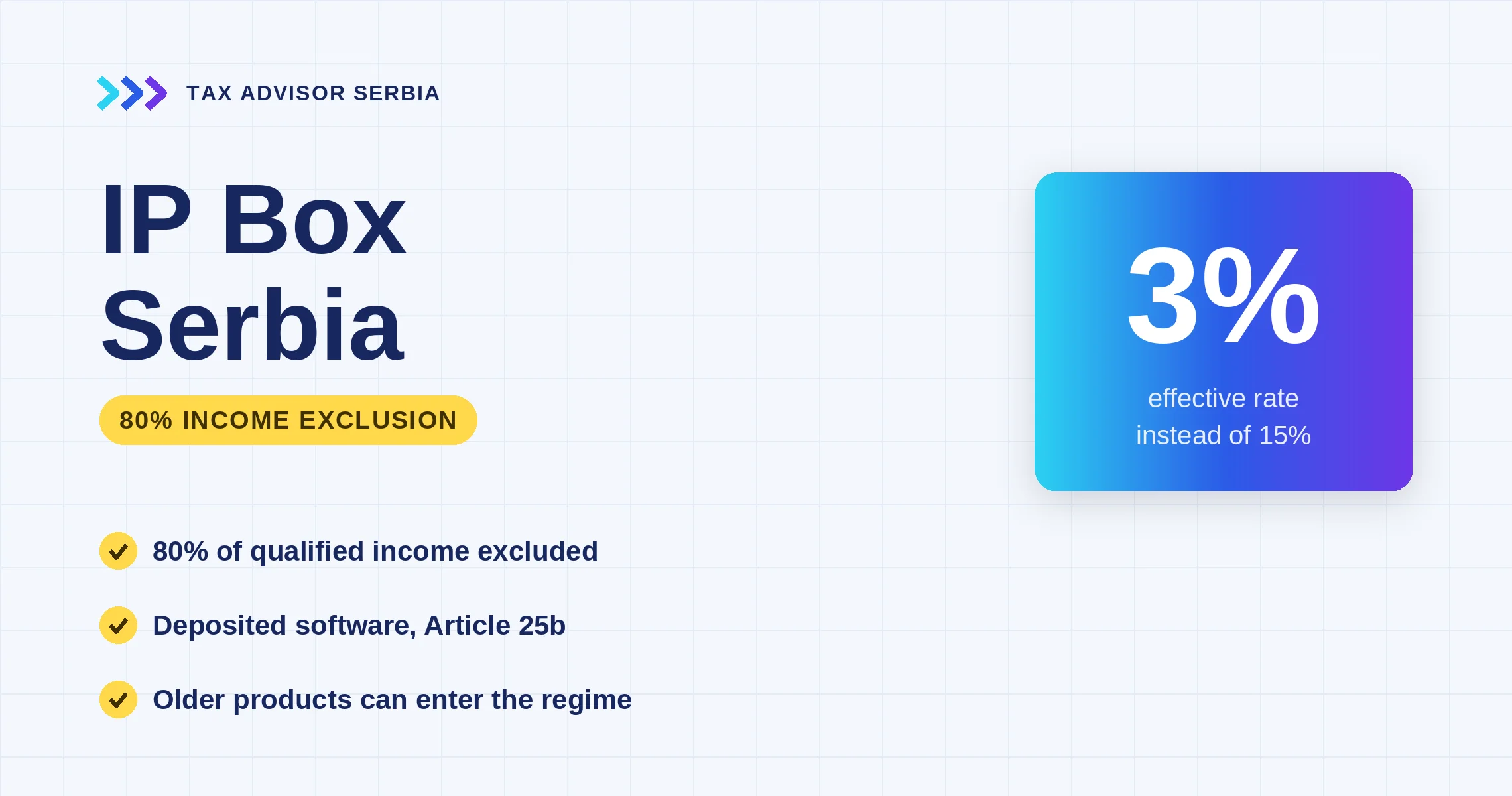
Serbia's corporate income tax rate is 15 percent. For software companies that own what they build, the law has offered a way to bring the rate on that product's income down to an effective 3 percent, and it has been sitting there since 2019. It is called the IP box, it lives in Article 25b of the Corporate Income Tax Law, and judging by how rarely it appears in practice, it is one of the least used serious incentives in the Serbian system.
The mechanics in one sentence: a company that holds a deposited copyright work, software above all, can exclude 80 percent of the qualified income earned from letting others use that work from its corporate tax base. Fifteen percent charged on one fifth of the income is an effective 3 percent.
Two clarifications before the details, because the terms get mixed constantly. The IP box is not the R&D double deduction from Article 22g, and it is not the payroll relief for development staff. Those are separate incentives with their own conditions. They can be combined with the IP box, but the combination changes the numbers in both directions, so it should be modelled before you opt in, not assumed.
Who is this for: companies that own product IP. A SaaS business, a product studio, a foreign owned subsidiary that holds the rights to what its Serbian team builds. Who is it not for: agencies working for hire, because the client owns the code and there is nothing to license, and revenue streams that only ride on the product without being payment for its use, advertising first among them.
And why so few use it: the relief is claimed through a calculation that requires a deposited work, a per product cost history and a specific form. None of that can be reconstructed credibly in the week before the tax return is due. Companies do not fail the eligibility test. They fail the preparation test.

The two conditions everything hangs on
First, the company must be the holder of the copyright or related right, and the work must be deposited with the Intellectual Property Office. The deposit is a quick administrative step and it is a lawyer's job, not mine. I work with an IP lawyer for exactly this, so if needed, the entire setup, deposit included, runs through me.
The holder condition has a useful edge case. Joint ownership does not break the regime: the Ministry of Finance confirmed in opinion no. 011-00-387/2022-04 of 20 June 2022 that a Serbian company registered as co holder of a deposited program together with a non resident partner can still use the incentive, provided the other conditions are met.
Second, the income must be consideration for the use of that deposited work. Subscription and licence fees your customers pay to use the software qualify. Two things do not. Selling the IP outright is excluded by the law itself, since the exclusion covers exploitation, not transfer of the right in full. And revenue that merely rides on the product is excluded too: the Ministry of Finance held in opinion no. 011-00-495/2020-04 of 9 September 2020 that advertising income earned inside an application does not qualify, even while the licence income from the same application does. Mixed monetisation models need their revenue split before anything else.
How the qualified income is calculated
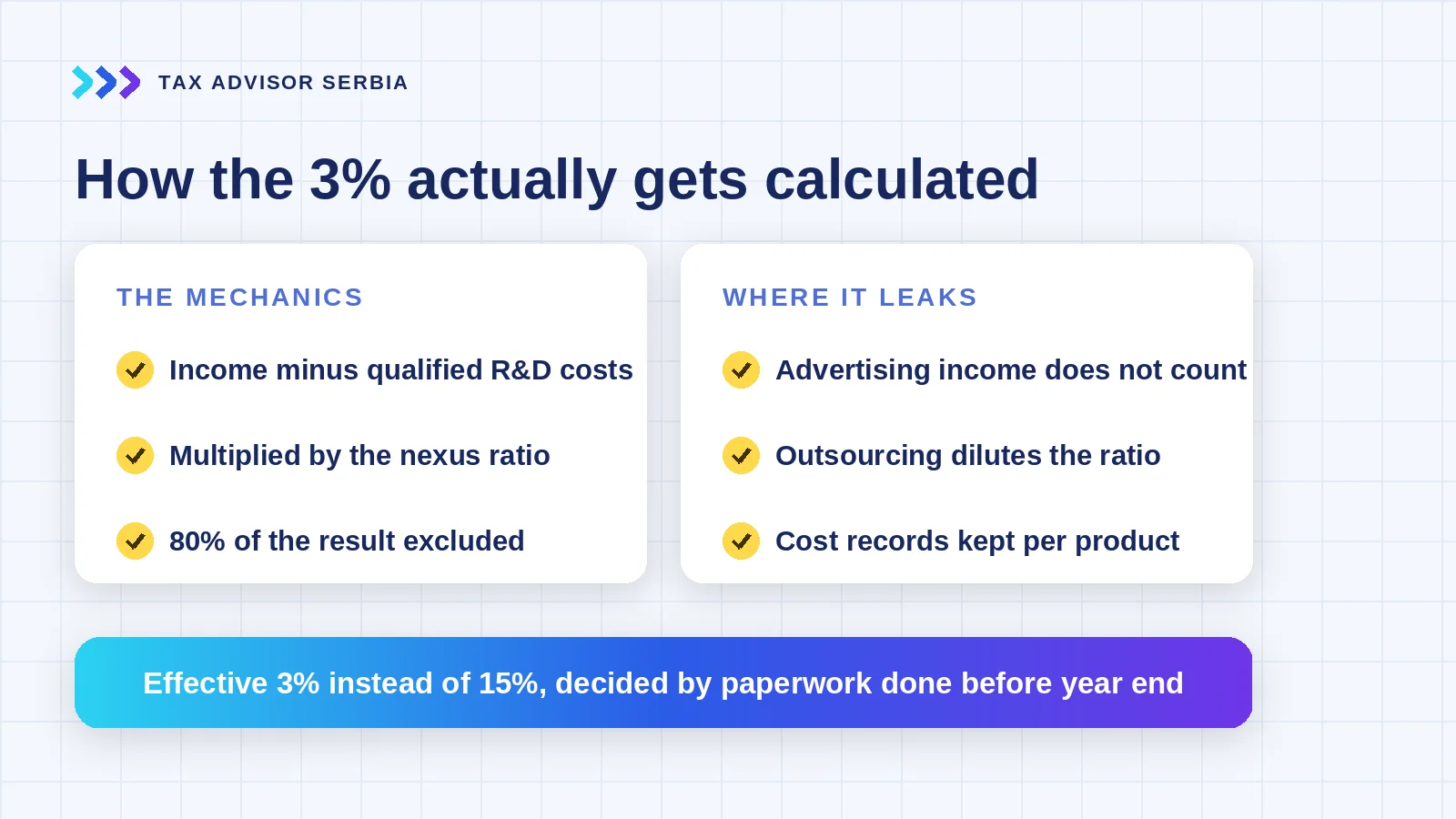
The exclusion is not applied to the raw licence revenue. The law runs it through two adjustments, and both can shrink the benefit materially.
The first is a deduction of qualified expenses: the historical and current tax recognised R&D costs that produced the work. What counts is defined by reference to the R&D cost list from Article 22g and its rulebook, and this applies whether or not the company actually uses the Article 22g deduction. Salaries of the people who built the product, materials, IP protection costs and similar items all enter this pool.
The second is the nexus ratio: the share of those qualified expenses in the total costs of the work. Total costs add, among other things, development outsourced to non residents and the above arm's length part of costs charged by related parties. The more of the product that was built outside the company, the lower the ratio, and the ratio multiplies the result.
A worked example through the OKP form
The numbers are illustrative. A Serbian d.o.o. built a SaaS product between 2023 and 2025, partly in house, partly through a non resident development contractor. It deposits the software in 2026 and applies the IP box for the first time in its 2026 tax balance.
Subscription income from the deposited software in 2026: RSD 60,000,000, roughly EUR 510,000. Advertising sold inside the product earned a further RSD 9,000,000 and stays out of the calculation entirely.
Qualified expenses: RSD 30,000,000 of historical in house development costs from 2023 to 2025, plus RSD 6,000,000 of current 2026 development on the same product, RSD 36,000,000 in total. Payments to the non resident contractor: RSD 12,000,000 historical and RSD 2,000,000 current. These do not count as qualified expenses, but they do enter total costs, which therefore come to RSD 50,000,000.
The OKP form then produces: income of 60,000,000 less qualified expenses of 36,000,000 gives 24,000,000. The nexus ratio is 36,000,000 over 50,000,000, which is 72 percent. Qualified income: 24,000,000 times 72 percent, or RSD 17,280,000. The exclusion is 80 percent of that, RSD 13,824,000, entered in the tax balance. At the 15 percent rate, the company pays about RSD 2,070,000 less corporate tax, roughly EUR 17,700, in year one.
Year two is where the regime opens up. The costs already used in year one cannot reduce the income again, so on the same revenue only the new year's development, RSD 6,000,000, comes off the top. The nexus ratio is recomputed on cumulative figures, RSD 42,000,000 of qualified expenses against RSD 58,000,000 of total costs, and stays at roughly 72 percent, because the outsourcing mix has not changed. Qualified income comes to about RSD 39,100,000, the exclusion to about RSD 31,280,000, and the annual saving rises to roughly RSD 4,690,000, about EUR 40,000, for every year the conditions hold. The early years carry the haircut. The later years carry the benefit.
The paperwork that decides the outcome
The calculation is filed on the OKP form, electronically, together with the tax balance, separately for each deposited work. The excluded amount flows into the tax balance and reduces the base. Behind the form, the rulebook requires a defined documentation set: the deposit confirmation, the revenue records for the work, the contracts under which customers use it, a specification of the development project, a per work record of total costs with the qualified part marked out, and a statement of the legal representative, given under criminal and material liability, that the cost records are complete. Where any of the costs arose with related parties, transfer pricing documentation is part of the set, which is one more reason the cost side deserves senior attention. That file is part of my transfer pricing work.
Timing rules worth knowing
The deposit does not have to precede the development, or even the revenue. It has to exist by the end of the first tax period for which the regime is applied, and historical costs still count. A product built years ago can enter the regime now.
Software changes constantly, and the rulebook accounts for that: updates of a deposited work do not each need their own deposit. They are covered if the latest version is deposited by the deadline for filing the tax return, and the versions keep the recognisable elements of the original work.
For works that predate 2019, a transitional rule replaces the unknowable historical cost records with deemed amounts: 60, then 40, then 20 percent of the work's revenue in the first three years of applying the regime.
One warning for the patent route: if a patent application is rejected, the exclusion stops and everything claimed on its basis is added back to the tax base in that year. Copyright deposits carry no such examination risk, which is one reason software sits so naturally in this regime.
Where companies lose the relief
- The client owns the code. Work for hire agencies transfer the IP as they build it, so there is no deposited right to license and no qualified income. This is the first filter, and it excludes most of the outsourcing industry.
- The revenue mix is never separated. Licence income qualifies, advertising and similar side streams do not, and without a clean split the calculation cannot be defended.
- Development was heavily outsourced abroad. Every dinar paid to non resident contractors stays in the denominator of the nexus ratio and dilutes the benefit, permanently.
- The cost records per product do not exist. The relief is claimed per deposited work, with a director's statement backing the numbers. A general ledger that never tracked costs by product cannot produce that record retroactively.
- Related party costs come without transfer pricing support. Group arrangements are common in exactly the companies this regime targets, and the documentation requirement follows them into the IP box file.
Frequently asked questions
Does my software qualify if it was developed before I ever heard of the regime?
Yes. The deposit has to exist by the end of the first year you apply the regime, not before development. Historical development costs enter the calculation, and products older than 2019 use the transitional deemed cost rule.
Do I have to deposit every release?
No. Later versions are covered together with the original, as long as the latest version is deposited by the tax return deadline and the product remains recognisably the same work.
Does SaaS subscription revenue count?
Yes. Fees paid to use the deposited software are the core case. Advertising income inside the same product does not count, and selling the IP outright does not either.
Can I combine the IP box with the R&D double deduction?
Yes, the law allows both. But the two interact inside the IP box calculation itself, and the combined effect is not automatically better. Model it before opting in.
What does using the regime cost in practice?
Three things. The deposit with the Intellectual Property Office, the per product cost records, and the annual OKP calculation with its documentation set. None of it is heavy for a company with orderly books, but all of it takes calendar time, and the deposit must exist before the tax year closes. The sensible start is therefore months before year end, not the last quarter. Whether it pays is best read from the example above: the first year saving there is a multiple of any realistic setup cost.
The IP box rewards exactly one thing: preparation done before the tax year closes. If your company owns its software and pays the full 15 percent, the question is not whether the regime exists. It is whether your deposit and your records will exist on time. I advise on eligibility, set up the cost tracking and prepare the OKP file as part of my corporate tax work. Book a free 15 minute call and I will tell you in one conversation whether the regime is worth a project in your case.
You may also want to read my Corporate Tax & Compliance services, Transfer Pricing & Audit Defense, and the Doing Business in Serbia 2026 guide.


.avif)
.avif)


.png)