

.svg)
Personal Income Tax & Expat Tax Services in Serbia
English-speaking personal income tax advisor for expats, remote workers, and freelancers in Serbia. PIT returns, residency, treaty relief - ex EY, fixed fees.

Serbian Personal Income Tax Advisory for Expats and Foreign Professionals
Serbia taxes salaries at a flat 10% - one of the lowest rates in Europe - and most other personal income at flat 15% or 20%. But the headline rates hide real complexity: an annual supplementary tax for higher earners, quarterly self-assessment for freelancers, residency rules that turn on 183 days and "center of vital interests," social contributions, and a Tax Administration portal (ePorezi) that works only in Serbian.
As a senior personal tax advisor with Big Four (EY) background, I help expats, remote workers, freelancers, and their employers get Serbian personal income tax right - in English, from residency determination through filing. When the Tax Administration sends a letter, I read it, respond to it, and represent you directly.
No juniors. No lost-in-translation moments with ePorezi.
I work with clients throughout Serbia - Belgrade, Novi Sad, Niš, Pančevo, Subotica - and remotely with expats worldwide, before and after relocation.
How a Personal Tax Engagement Works
Every engagement starts with a free 15-minute call. I review your residency position, income sources, and any filings already made, then send a clear proposal within 24 hours - defined deliverables, fixed fee, no hourly billing.
Whether you need a one-time annual return, a residency and structure assessment before you move, or year-round compliance as a freelancer, the approach is the same: senior execution, fixed fees, everything explained in plain English.
Core Personal Tax and Expat Services
- Tax residency determination and certificate of residence support
- Annual personal income tax return preparation and filing (May 15 deadline)
- Freelancer quarterly self-assessment (PP OPO-K) - model selection and filing
- Structure analysis for foreign income - flat-rate entrepreneur, bookkeeping entrepreneur, freelancer regime, or DOO
- Newly-settled taxpayer incentive applications for qualifying new residents
- Double tax treaty relief and foreign tax credit claims
- Social contribution calculations for employees, entrepreneurs, and freelancers
- Employer advisory on hiring expats and international remote workers in Serbia
- Tax Authority correspondence and audit defense

Freelancer and Self-Employed Tax in Serbia
If you earn income from foreign clients while living in Serbia, you have four legal structures to choose from - and they produce very different effective tax rates at different income levels. Freelancers under the self-assessment regime file quarterly (Form PP OPO-K, within 30 days of quarter end) and can switch between two taxable-base models every quarter. Flat-rate entrepreneurs (pausalac) pay a fixed monthly amount up to a RSD 6 million annual turnover ceiling. Choosing wrong can cost thousands of euros per year. I run the comparison on your actual numbers before you commit - see my guides on how quarterly freelancer self-assessment works and which structure wins for foreign income.
Common Personal Tax Scenarios I Solve
Most clients come to me with one of these:
- "I just moved to Serbia and have no idea whether I'm a tax resident."
- "I work remotely for a foreign company - how do I report this income, and which structure saves me the most?"
- "I received a letter from the Tax Administration and everything is in Serbian."
- "My income crossed the annual tax threshold and I need to file by May 15."
- "I'm a freelancer and want to know whether switching to pausalac would save me money."
- "We're hiring an international employee and want to secure the newly-settled taxpayer incentive."
- "I need a certificate of residence to claim treaty relief on foreign income."
If any of these sound familiar, you're in the right place. Not sure whether you owe annual tax at all? Try my free Annual PIT Calculator - it takes two minutes.


Frequently Asked Questions About Personal Income Tax in Serbia
What is the personal income tax rate in Serbia?
Employment income (salaries) is taxed at a flat 10% - among the lowest in Europe. Most other income types are taxed at flat rates: 15% on capital gains and dividends, 20% on rental income and royalties. Higher earners also pay a supplementary annual personal income tax on total income above a threshold tied to the average annual salary. Full expat guide to annual personal income tax.
Who is considered a tax resident of Serbia?
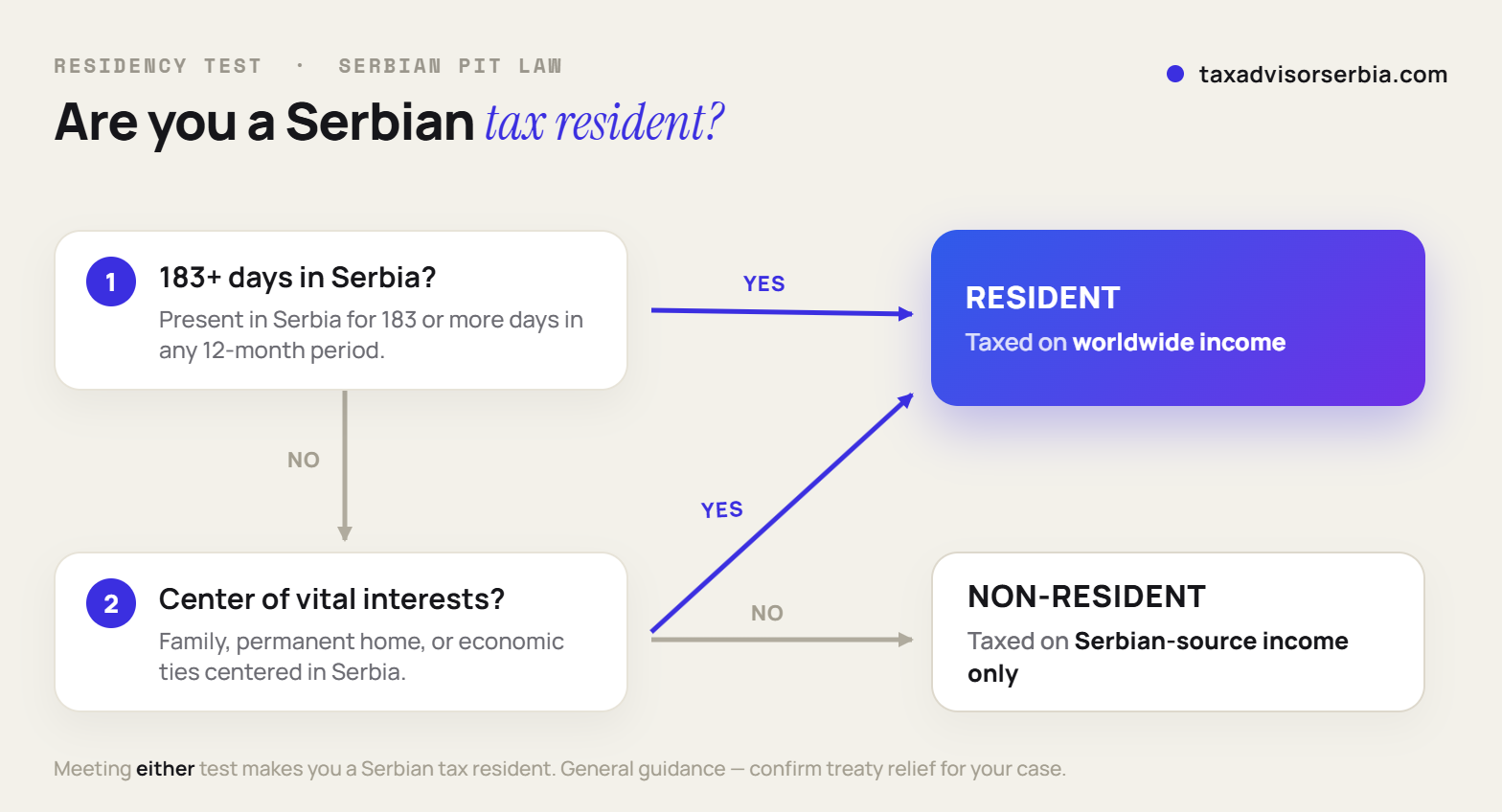
You are a Serbian tax resident if you have your permanent home or center of personal and business interests in Serbia, or if you spend 183 or more days in Serbia within any 12-month period. Residents are taxed on worldwide income; non-residents only on Serbian-source income. Residency determination is the single most important question for any expat - it decides what you report and where.
Do I need to file an annual tax return in Serbia?
If your combined income from all taxable sources exceeds a threshold (three times the average annual salary), you must file an annual personal income tax return by May 15 of the following year - even if tax was already withheld during the year. The annual return is filed electronically. Many expats with a high salary or multiple income sources are surprised to learn they have this obligation.
What is the under-40 annual tax relief?
Taxpayers under 40 years of age receive a substantial additional deduction when calculating annual personal income tax, which can significantly reduce or even eliminate the annual liability. If you are approaching 40, the timing of large income events (bonuses, equity payouts) matters. Check your position with my free Annual PIT Calculator.
How are freelancers taxed in Serbia?
Freelancers earning income from foreign clients report quarterly on Form PP OPO-K, within 30 days of each quarter end. You choose between two models for calculating the taxable base - and you can switch models every quarter. For 2026, Model 1 gives a fixed standardized deduction of RSD 110,647 per quarter. Complete PP OPO-K guide.
What is the best structure for receiving foreign income in Serbia?
Serbian law allows four forms: flat-rate entrepreneur (pausalac, up to RSD 6 million turnover per year), bookkeeping entrepreneur, the freelancer self-assessment regime, and a limited liability company (DOO). At higher income levels the effective rates diverge sharply - the right answer depends on your numbers, not on administrative convenience. Detailed comparison of all four models.
What is the newly-settled taxpayer incentive?
Serbia offers a significant reduction of the taxable salary base for qualifying newly-settled residents - typically foreign professionals and returnees taking employment with a Serbian employer above a minimum salary threshold. The incentive must be secured correctly at the start of employment. I handle eligibility assessment and the application process.
How do I get a tax identification number in Serbia as a foreigner?
Foreign individuals are registered with the Serbian Tax Administration using a personal identification number - for foreigners without a Serbian personal number, the Tax Administration assigns a foreigner registration number. You'll need it for any filing, from annual returns to freelancer self-assessment. I handle the registration as part of onboarding for every new client.
Do expats pay social contributions in Serbia?
Employees on Serbian payroll pay mandatory pension, health, and unemployment contributions, withheld from salary. Freelancers and entrepreneurs pay contributions through their respective regimes. If your home country has a social security agreement with Serbia, you may remain in your home system with the proper certificate of coverage - this needs to be checked before you start working, not after.
How are dividends and capital gains taxed for individuals?
Both are taxed at flat 15% for Serbian tax residents. For dividends from Serbian companies, tax is withheld at source. Capital gains are self-reported. Non-residents face withholding on Serbian-source income, subject to treaty relief. Shareholders' guide to Serbian dividend taxation.
Is there a personal income tax calculator for Serbia?
Yes - I built a free Annual PIT Calculator that estimates your Serbian annual personal income tax liability, including the under-40 relief. It takes about two minutes and requires no registration.
Related Personal Tax Reading


.png)