

.svg)
Transfer Pricing Services in Serbia
Transfer pricing advisor for domestic and foreign-owned companies. OECD-aligned documentation, benchmarking, and audit defense - ex EY, fixed-fee execution.
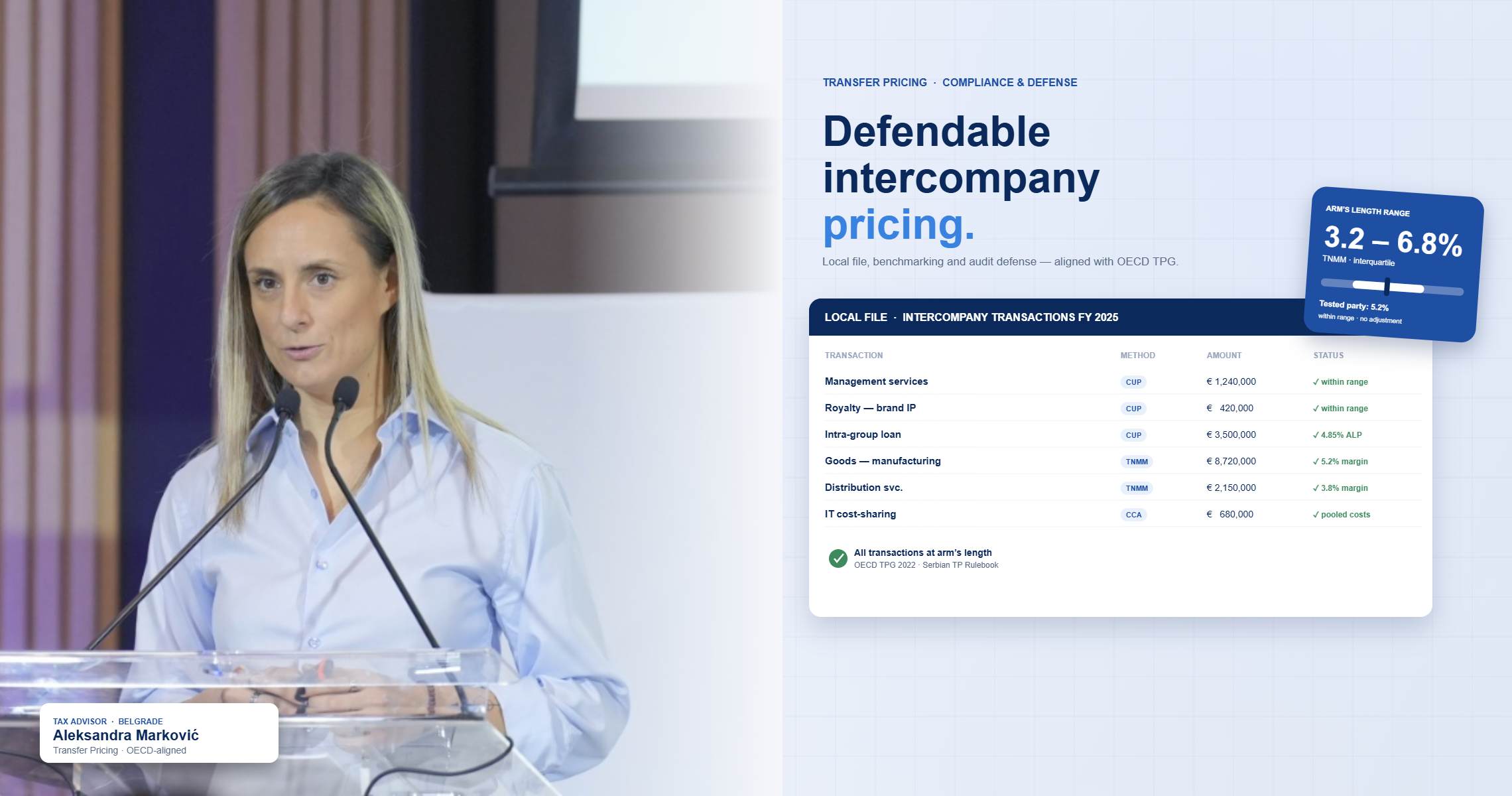
Serbian Transfer Pricing Advisory for Companies with Related-Party Transactions
Serbian transfer pricing rules require companies with related-party transactions - domestic Serbian groups and foreign-owned subsidiaries alike - to prepare annual documentation proving arm's length pricing. Non-compliance triggers penalties and tax adjustments, and TP is increasingly an audit priority for the Tax Authority.
I prepare fully compliant transfer pricing documentation grounded in both Serbian law and OECD guidelines, by a senior transfer pricing advisor with Big Four (EY) background. For Serbian groups, that means documentation that holds up under Tax Authority audit. For foreign-owned subsidiaries - particularly groups headquartered in Germany, Switzerland, Austria, or elsewhere in the EU - the OECD-aligned approach means the Serbian study fits seamlessly into your group's broader European TP framework. Local sign-off can be added where specific country requirements apply.
No outsourced juniors. No template-filled studies that fall apart under audit.
How a Transfer Pricing Engagement Works
Every engagement starts with a free 15-minute call. I review your group structure, intercompany transactions, and existing documentation (if any), then send a clear proposal within 24 hours - defined deliverables, fixed fee, no hourly billing.
Whether you need ongoing transfer pricing consulting for a complex group structure, a one-time transfer pricing advisor to review existing documentation, or full audit defense, my approach is the same: senior execution, fixed fees, clear deliverables.
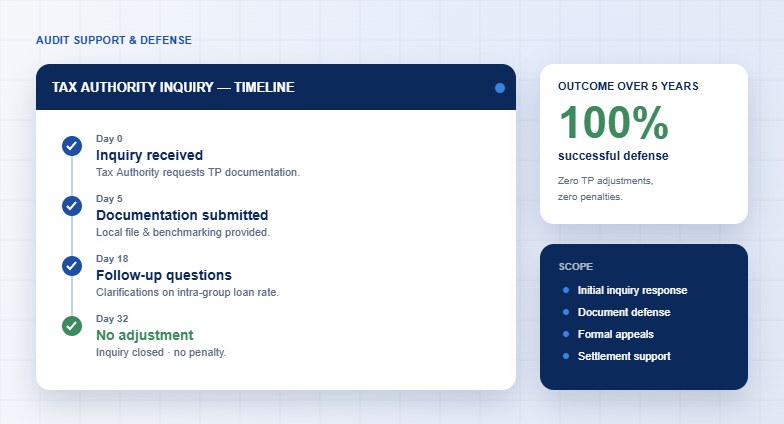
You work with me directly from initial scoping through final documentation. For audit defense engagements, I represent you with the Serbian Tax Authority from first query through resolution.
Core Transfer Pricing Services
- Full TP documentation aligned with OECD guidelines and Serbian law
- Benchmarking studies using external commercial databases
- Intercompany agreement review and template design
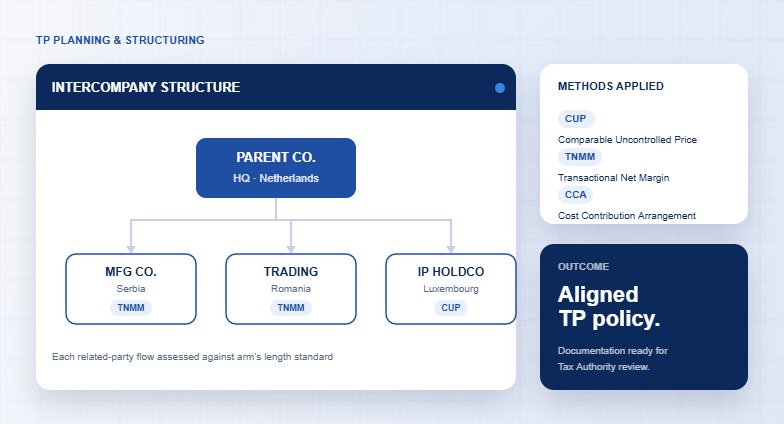
- Transfer pricing policy design for new group structures (cost plus, distributor margins, royalty rates)
- Year-end TP adjustments and customs alignment
- Audit defense and Tax Authority correspondence
- Master file and local file preparation for groups with CbCR obligations
- TP risk assessment for new or restructured transactions
Ongoing Transfer Pricing Compliance
Once your TP documentation is in place, I keep it current year-over-year. Annual updates account for changes in your group structure, intercompany transaction volume, and benchmarking data refresh. When the Tax Authority reaches out - and for TP, they often do - you have a senior transfer pricing advisor responding directly, not a service ticket.
For multinational groups operating across the region, I align documentation across multiple jurisdictions so your Serbian study fits into the larger European TP framework - no contradictions, no gaps that auditors can exploit.
Common Transfer Pricing Scenarios I Solve
Most clients come to me with one of these:
- "We're a Serbian group with related-party transactions and need annual TP documentation."
- "We have a Serbian subsidiary of a German, Austrian, Swiss, or other European group."
- "We restructured last year and need updated TP analysis for new intercompany flows."
- "The Tax Authority is questioning our intercompany interest rate, management fee, or royalty."
- "Our group's TP policy is set at headquarters but we need a Serbian local file."
- "We failed a TP audit and got adjustments - can you handle the appeal?"
- "Year-end adjustment is needed but customs may flag it - how do we structure it?"
- "We need benchmarking for distributor margins, cost plus, or financial transactions."
- "We're claiming the IP box and our development costs sit with related parties - the file needs TP support."
If any of these sound familiar, you're in the right place.


Frequently Asked Questions About Transfer Pricing in Serbia
What is transfer pricing and how is it calculated in Serbia?
Transfer pricing refers to the pricing of transactions between related companies - affiliates, parents, subsidiaries, or entities under common control. Serbian law requires these transactions to be priced as if they were between independent parties (the arm's length principle). Calculation involves selecting a transfer pricing method - the five OECD-recognized methods are CUP (Comparable Uncontrolled Price), Cost Plus, Resale Price, TNMM (Transactional Net Margin Method), and Profit Split - performing benchmarking against comparable independent transactions, and documenting the analysis in a TP study.
What is the transfer pricing threshold in Serbia?
Short-form reporting is available when individual related-party transaction values, or aggregate annual transactions with a single related party, fall below RSD 8 million. Above this threshold, full transfer pricing documentation is required - including method selection, benchmarking, economic analysis, and intercompany agreement review.
When is the deadline for transfer pricing documentation in Serbia?
Transfer pricing documentation is submitted alongside the annual corporate income tax return - for calendar-year companies, by June 30 of the following year.
What does a transfer pricing advisor actually do?
A transfer pricing advisor analyzes intercompany transactions between related companies, selects the appropriate TP method, conducts benchmarking against independent comparables, and prepares documentation that proves arm's length pricing to tax authorities. For audit defense, the advisor represents the company in correspondence and meetings with the Tax Authority. Senior advisors handle this directly; in larger firms, junior staff often do the foundational work.
What are the penalties for non-compliance with transfer pricing rules in Serbia?
Penalties for non-compliance with Serbian transfer pricing rules range from RSD 100,000 to RSD 2 million per offense, depending on the violation. Beyond direct penalties, tax adjustments based on incorrect transfer prices can result in significant additional corporate income tax liability, plus interest.
Can a single TP study cover multiple European jurisdictions?
Yes - transfer pricing documentation built on OECD guidelines is broadly portable. For Serbian companies expanding abroad, or for foreign-owned subsidiaries that already have group-level TP policies, OECD alignment means the Serbian study serves as a strong foundation across jurisdictions. Local sign-off can be added where specific country requirements exist, but the core analysis - comparability, method, benchmarking - is built once, properly.
Do I need a master file and local file for Serbian TP?
Local file is required for Serbian entities meeting documentation thresholds. Master file is required for groups subject to country-by-country reporting (CbCR) - generally when consolidated group revenue exceeds EUR 750 million. For smaller groups, local file alone is sufficient.
How do you handle benchmarking studies?
I use external databases to identify comparable independent companies, applying OECD-compliant search strategies and rejection criteria. The benchmarking range supports the arm's length pricing of your intercompany transactions. Each study is custom-built for your specific transactions, not pulled from generic templates.
What happens during a transfer pricing audit in Serbia?
The Tax Authority typically opens an audit with information requests covering your TP documentation, intercompany agreements, and supporting analysis. I represent you throughout - responding to queries, attending meetings, and defending the methodology. My documentation is built with audit defense in mind from day one, so when challenges come, the answers are already in the file.
Related Transfer Pricing Reading


.png)