

.svg)
Withholding Tax Services in Serbia
Withholding tax advisor for cross-border payments from Serbia. Treaty relief applications, WHT refunds, dividend and royalty WHT - ex EY, fixed fees.
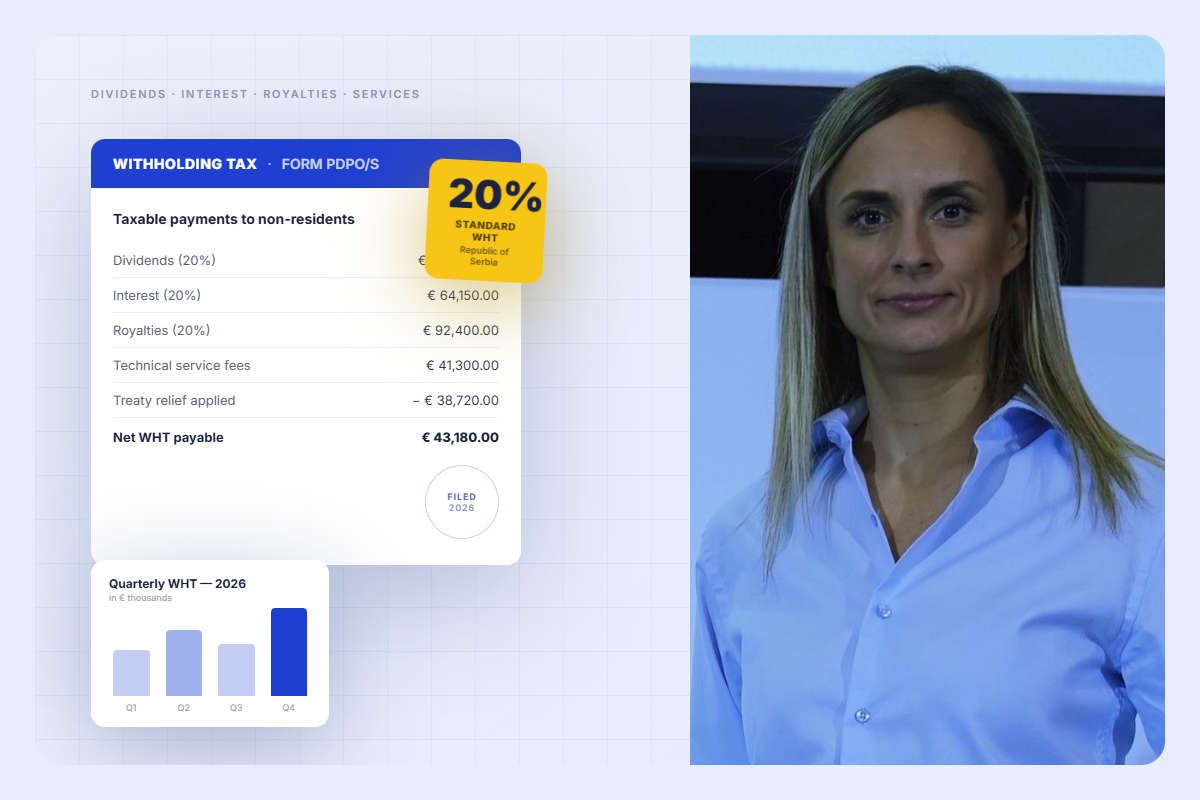
Serbian Withholding Tax Advisory for Companies Making Cross-Border Payments
Serbia applies withholding tax (WHT) on dividends, interest, royalties, lease and sublease payments, and certain service fees paid to non-resident legal entities. The standard rate is 20 percent, a 25 percent rate applies to most payments toward jurisdictions with a preferential tax system, and the compliance burden sits entirely with the Serbian payer: the tax must be calculated, withheld, reported and paid within three days of each payment. Get the classification or documentation wrong, and you either overpay or face penalties and interest.
I handle the full WHT process as a senior withholding tax advisor with Big Four (EY) background - analyzing each payment type, applying the correct rate, and securing treaty relief where Serbia's network of more than 60 double tax treaties allows it. For foreign-owned subsidiaries - particularly groups headquartered in Germany, Switzerland, Austria, or elsewhere in the EU - that means intercompany dividends, royalties and interest flow at the treaty rate, with the paperwork in place before the money moves. I work for payers and recipients alike.
No missed three-day deadlines. No paying 20 percent when the treaty says 5.
How a Withholding Tax Engagement Works
Every engagement starts with a free 15-minute call. I review your cross-border payment flows, the underlying contracts, and any documentation already in place, then send a clear proposal within 24 hours - defined deliverables, fixed fee, no hourly billing.
Whether you need one-time WHT advisory on a specific payment, ongoing withholding tax compliance for recurring royalty and interest flows, or a refund claim for tax already overpaid, my approach is the same: senior execution, fixed fees, clear deliverables.
You work with me directly from initial analysis through filing. For refund claims and Tax Authority queries, I represent you from first submission through resolution.
Core Withholding Tax Services
- WHT analysis and calculations on dividends, interest, royalties, lease payments, and service fees
- Double tax treaty analysis and reduced-rate application
- Tax residency certificate requests and treaty relief documentation
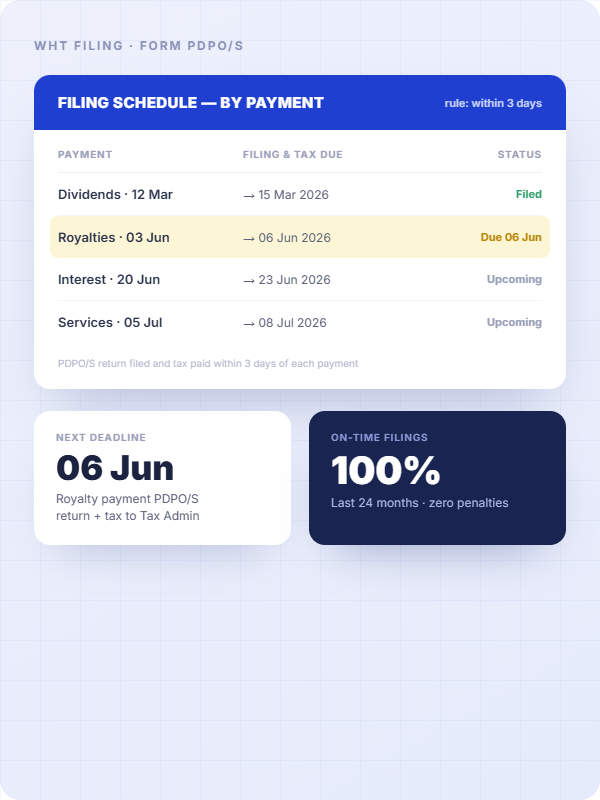
- WHT return (PDPO/S) preparation and filing within the three-day statutory deadline
- WHT refund claims for tax withheld above the treaty rate
- Review of intercompany royalty, interest, and service agreements before payment
- WHT treatment opinions for software, digital services, and platform fees
- Audit defense and Tax Authority correspondence on WHT positions

Ongoing Withholding Tax Compliance
Recurring cross-border payments - monthly royalties, quarterly interest, intercompany service fees - mean recurring WHT obligations. I keep the process running year-round: residency certificates renewed before they lapse, each payment classified and filed within the three-day deadline, and treaty positions updated when agreements or group structures change.
When the Tax Authority asks why a reduced rate was applied - and for treaty relief, they do ask - you have a senior advisor responding directly with the documentation already in the file, not a service ticket.
Common Withholding Tax Scenarios I Solve
Most clients come to me with one of these:
- "We're paying dividends to our foreign parent - what rate applies and what documents do we need before payment?"
- "Our Serbian subsidiary pays royalties and management fees to the group - is WHT due, and can the treaty reduce it?"
- "We paid the full 20 percent because the residency certificate arrived late - can we recover the difference?"
- "Do we owe WHT on LinkedIn, Google, or other software and platform fees?"
- "We're paying a US company and there's no treaty - what are our options?"
- "The Tax Authority is questioning the treaty rate we applied three years ago."
- "We're liquidating our Serbian entity and distributing what's left to the foreign owner."
- "Our foreign lender wants interest paid gross - who bears the WHT cost?"
If any of these sound familiar, you're in the right place.


Frequently Asked Questions About Withholding Tax in Serbia
What is the withholding tax rate in Serbia?
The standard withholding tax rate in Serbia is 20 percent. It applies to dividends, interest, royalties, lease payments and certain service fees paid to non-resident legal entities. A higher rate of 25 percent applies to royalties, interest, lease payments and service fees paid to entities from jurisdictions with a preferential tax system, while dividends paid to those jurisdictions remain taxed at 20 percent. A double tax treaty can reduce these rates significantly.
Which payments from Serbia are subject to withholding tax?
Serbian WHT applies to dividends and profit shares, interest, royalties and related intellectual property income, lease and sublease of real estate and movable property in Serbia, and fees for market research, accounting, auditing and other legal and business consulting services paid to non-resident legal entities, regardless of where those services are provided or used. Payments between two Serbian resident companies are outside the WHT regime.
How do double tax treaties reduce Serbian withholding tax?
Serbia has double tax treaties with more than 60 countries. Treaties typically reduce WHT on dividends to 5 or 15 percent depending on the ownership share, and often lower the rates on interest and royalties as well. To apply a treaty rate, the non-resident recipient must provide a tax residency certificate on the prescribed form before the payment is made, and beneficial ownership conditions must be met.
What is a tax residency certificate and how long is it valid?
A tax residency certificate is the document proving the income recipient is a resident of a treaty country. For treaty relief in Serbia it must be provided on the form prescribed by the Serbian Ministry of Finance, certified by the foreign tax authority, or as a foreign certificate accompanied by a certified translation. Certificates are issued per calendar year, so recurring payments require renewed certificates - a step that is easy to miss and expensive when missed.
Does Serbia have a double tax treaty with the United States?
No. Serbia does not have an income tax treaty with the United States, so dividends, interest and royalties paid to US recipients are subject to the full domestic withholding tax rate of 20 percent. US recipients may be able to claim a foreign tax credit at home, which should be confirmed with a US tax advisor.
What is the deadline for filing a withholding tax return in Serbia?
The Serbian payer must calculate and withhold the tax, file the withholding tax return (PDPO/S form) and pay the tax within three days from the date of payment. A return is generally required even when a treaty exemption applies, indicating the legal basis for non-taxation.
Is withholding tax due on software licenses and digital platform fees?
It depends on how the payment is classified. Fees that qualify as royalties for the use of intellectual property can trigger WHT, while payments for standardized software or services outside the taxable categories generally do not. Classification drives the outcome, so each contract should be reviewed before payment rather than after.
Can overpaid withholding tax in Serbia be refunded?
Yes. If tax was withheld at the full domestic rate even though a lower treaty rate applied, the non-resident recipient can claim a refund of the difference from the Serbian Tax Authority. The claim requires a tax residency certificate and supporting documentation, and I manage the process from filing to payment.
What are the penalties for withholding tax non-compliance in Serbia?
Missing the three-day filing and payment deadline, applying a treaty rate without valid documentation, or misclassifying a payment exposes the Serbian payer to misdemeanor penalties, payment of the under-withheld tax, and interest. Because the payer bears the liability, the safest position is having the classification and treaty documentation confirmed before the payment is made.
Related Withholding Tax Reading
Dividend Tax Treatment in Serbia: What Shareholders Need to Know
Tax Treatment of LinkedIn Fees in Serbia: Withholding Tax or Not?
Serbia: Do You Need to File a Tax Return Even When No Tax Is Payable?
Liquidating a Serbian entity: the tax layer nobody maps in advance
US Serbia Tax Treaty: Why There Is No Treaty and What It Means (2026)


.png)