

.svg)
Serbia Tax Residency: The 183-Day Rule, Vital Interests and the Certificate (2026)
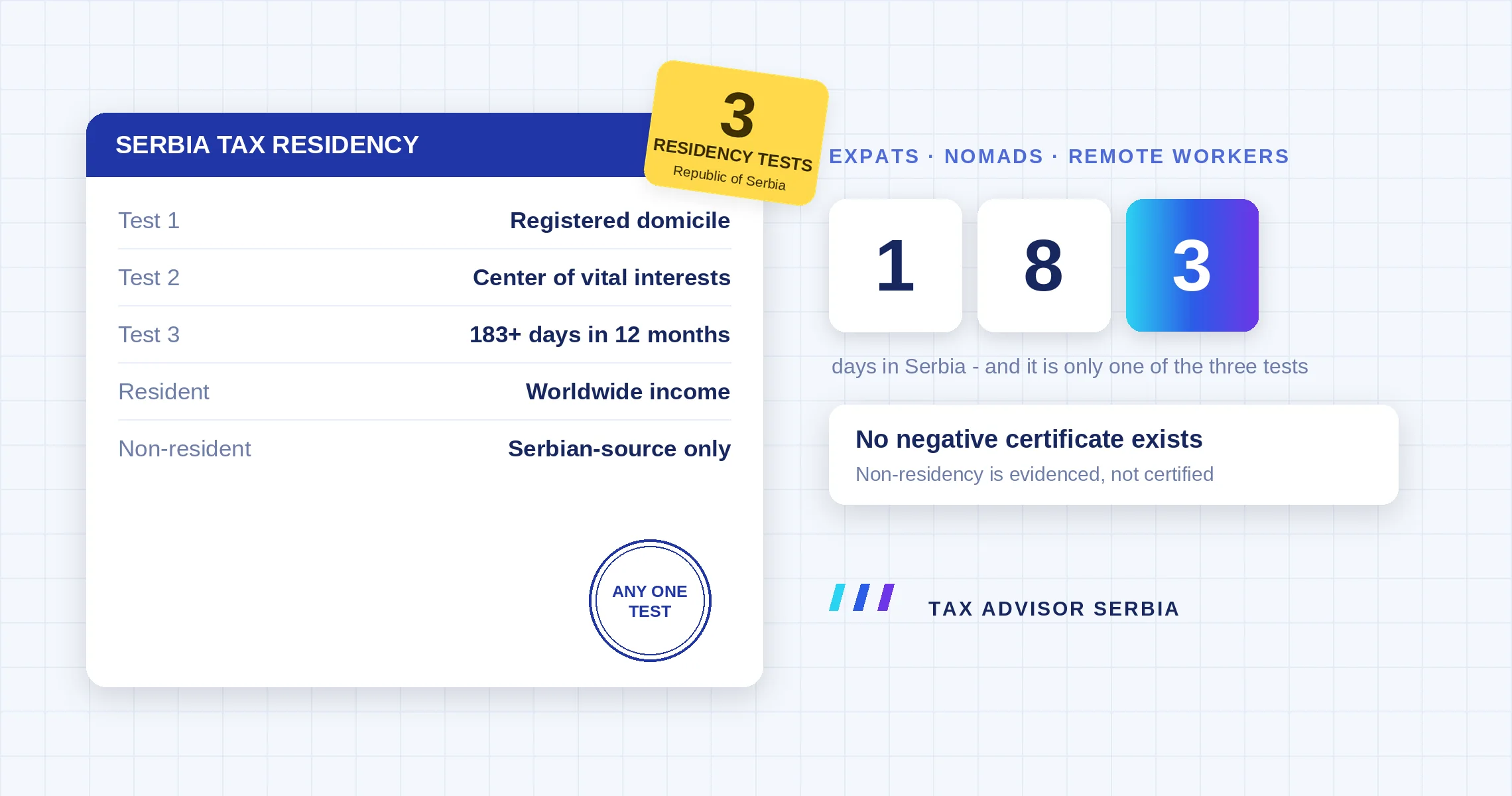
You are a Serbian tax resident if you meet any one of three tests under Article 7 of the Personal Income Tax Law: you have a registered domicile (prebivalište) in Serbia, your center of business and vital interests is in Serbia, or you spend 183 or more days in Serbia within any 12-month period beginning or ending in the tax year. Residents are taxed on their worldwide income; non-residents only on Serbian-source income.
Most guides stop at the 183 days. In practice, that is where the mistakes begin - the other two tests regularly override the day count, non-residents still owe Serbian tax on some income, and proving your status works very differently from what people expect. This guide covers the rules and the practice, including the residency certificate procedure.
The three residency tests
Registered domicile (prebivalište). A formal test with real teeth: if your registered permanent address in Serbia stays active, you can be treated as a Serbian tax resident even while living abroad. In an official Ministry of Finance opinion, a person working in another country - one without a tax treaty with Serbia - was deemed a Serbian resident purely because their Serbian domicile registration remained, regardless of where their family lived.
Center of business and vital interests. Where your life actually happens: home, family, economic ties. More on how this is assessed below - it is the test that most often surprises people.
183 or more days. The famous one - and the most misunderstood.
How the 183 days are actually counted
The count runs over any 12-month period beginning or ending in the relevant tax year - not the calendar year, as several popular guides wrongly claim. Days do not need to be consecutive.
Three details matter in practice. Part of a day counts as a full day - any presence between 00:00 and 24:00, with a single exception for transit through Serbia. Arrival and departure years are split: if you were not a resident before first entering Serbia, you are not treated as a resident for the part of the year before entry (and mirror rules apply to the year of final departure). And the least known rule: if you already know at the moment of first entry that you will meet a residency test - say, you arrive on an indefinite local employment contract - you are a resident from day one, not from day 183.

The center of vital interests: the test that overrides your day count
You can spend 150 days in Serbia and still be a Serbian tax resident - and you can leave Serbia and remain one. The center of vital interests looks at where your personal and economic life is anchored, and the Tax Administration assesses it case by case, with access to the Ministry of Interior's records of your registered addresses.
What counts as evidence is not guesswork - the official rulebook on residency certificates lists it. When a foreigner claims Serbian residency based on vital interests, the Tax Administration looks for:
- Residence documentation for the applicant and family members living in Serbia
- School, kindergarten or university enrollment certificates for children
- Ownership or another real right over a house or apartment
- A local employment contract or secondment agreement
Read that list in reverse and you see what keeps you tied to Serbia after you leave: a spouse and children who stayed, an apartment in your name, an active local employment. Counting your own days meticulously while your family's life continues in Belgrade is not a plan - it is a finding waiting to be made.
I'm a non-resident - do I still owe Serbian tax?
Yes, on Serbian-source income - and income from work you physically perform while in Serbia falls in that category, even if your employer or clients are entirely foreign.
Domestic law gives foreigners one safe harbor: income of a non-resident who spends up to 90 days in Serbia within a 12-month period is exempt, provided it comes from a foreign principal that does not do business in Serbia (Article 9b of the PIT Law). The exemption also covers work for a foreign principal that does operate in Serbia, but only if your service does not serve that Serbian activity. Beyond 90 days, day counting alone will not protect you - a tax treaty might, but only if you can actually prove tax residence in another country, and which treaty article applies depends on how your work is structured.
Remote work from Serbia for a foreign employer
A pattern I see weekly: someone moves to Serbia but stays formally employed in their home country - a Russian, German or US employment contract - and assumes their "employment abroad" keeps Serbian tax away. It does not, and the label on the contract matters less than people think.
From the Serbian perspective, what matters is where the work is physically performed and the economic substance of the arrangement - and a foreign employer with no presence in Serbia cannot operate Serbian payroll. For a Serbian tax resident, that generally pushes the income into quarterly self-assessment, whatever your foreign contract says. There are cleaner ways to structure this - and the difference between an informal remote setup and a properly structured one is usually measured in thousands of euros per year and one tax audit. Which structure fits depends on your numbers, your employer and your plans, and that is a planning conversation, not a blog paragraph.
My freelancer tax guide covers how the quarterly self-assessment works, and the annual personal income tax guide covers what happens above the annual thresholds.
If you have recently relocated, two more pieces complete the picture: how to get a Serbian tax identification number and, for eligible newcomers, the newly-settled taxpayer incentive.
Not sure which side of these rules you are on? I assess residency status and the resulting obligations as a fixed-fee engagement - get in touch.
Dual residency and tax treaties: the tie-breakers
If both Serbia and another country claim you as a resident under their domestic laws, the tax treaty between them (if one exists) resolves the conflict through tie-breaker rules, applied strictly in order: permanent home available to you; if in both states, center of vital interests; then habitual abode; then nationality; and finally mutual agreement between the two tax authorities.
One procedural point decides most real cases: treaty residency of the other country is proven exclusively with a residency certificate issued by that country's competent authority. Without it, claims about where you "really" live carry little weight with the Serbian Tax Administration.
How to get a Serbian tax residency certificate (POR-1)
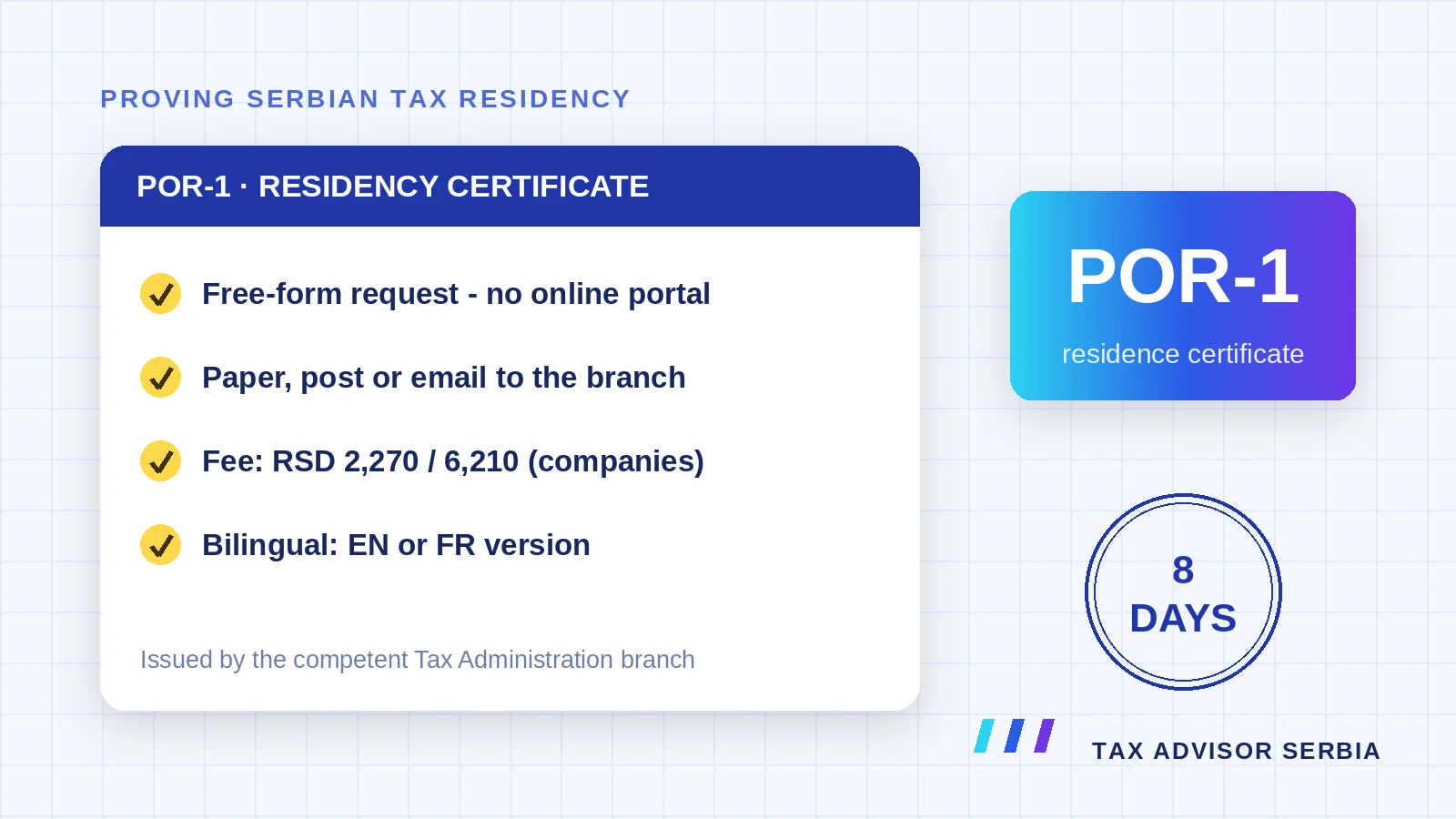
The POR-1 certificate proves your Serbian tax residency to a foreign payer, so treaty benefits can be applied abroad. The competent Tax Administration branch issues it within 8 days of a complete request - but there is no online portal and no standard form: the request is a free-form letter with mandatory elements, submitted on paper, by post or by email to the right branch, with an administrative fee (currently RSD 2,270 for individuals, RSD 6,210 for companies). It can cover the current and previous years, in bilingual Serbian/English or Serbian/French versions.
The documentation is where it gets less simple. For Serbian individuals, the file is light - essentially a recent domicile certificate. For foreigners, it is heavier: identity and residence-permit documents, address registration, employment or property evidence - and if your residency rests on family ties, a parallel file for the family members as well. The exact set depends on which residency test you rely on, and that choice is where requests stall: argue the wrong basis and the branch asks for more evidence, the clock resets, and your foreign payer's payment date passes without the certificate. I prepare and file POR-1 requests for clients as a fixed-fee service, with the basis argued right the first time.
Proving foreign residency to a Serbian payer (POR-2)
The mirror situation: a non-resident receiving income from Serbia proves their treaty residency with a POR-2 certificate (or the foreign authority's own form). The critical rule sits with the payer: if the Serbian payer does not hold the certificate at the moment of payment, the treaty cannot be applied and tax must be withheld at full domestic rates. Getting relief after the fact is a much harder road - my withholding tax services page covers these situations.
Leaving Serbia: how residency ends
Residency does not end with a plane ticket - and Serbia will not issue you a paper saying it has. Only positive residency certificates exist: if you ask the Tax Administration to confirm you are not a resident, the request is formally rejected. Your non-residency is something you evidence, not something you certify.
The good news: Ministry of Finance practice confirms a clean exit is achievable - there are formal steps with the Ministry of Interior, a day-count discipline, and an evidence file to build for the years that follow, and when they are done in the right order, non-residency holds. Done in the wrong order, or half-done, the domicile and vital-interests tests quietly keep you taxable on your worldwide income for another year or more - and the Tax Administration can see your full address registration history when it checks. Exit planning is a one-time engagement, and it costs a fraction of one year of accidental residency.
Frequently asked questions
Is tax residency the same as a residence permit?
No. A residence permit is an immigration status; tax residency is determined separately under the tax law tests. A permit can serve as evidence in a residency assessment, but holding one does not by itself make you a tax resident - and lacking one does not protect you from becoming one.
Can I be a tax resident of nowhere?
Practically, some nomads end up without treaty residency anywhere - and that position is weaker, not stronger: no treaty protection applies, and only the domestic 90-day exemption remains for work performed in Serbia.
Do days in transit count toward the 183 days?
No - transit through Serbia is the only exception. Any other presence during part of a day counts as a full day.
I moved abroad but kept my registered address in Serbia. Am I still a resident?
Very likely yes - registered domicile is a standalone residency test, and official practice treats it that way even when your family lives abroad. It is the single most overlooked step when leaving.
How long does the residency certificate take?
Eight days from a complete request, issued by the competent Tax Administration branch. Plan around payment dates - a foreign payer typically needs it before paying you, not after.
Residency status decides everything downstream: what Serbia taxes, which treaty applies, which filings you owe. If yours has never been properly assessed - or you are planning an arrival or an exit - that is exactly what my fixed-fee residency review covers: a written conclusion you can rely on, and the steps in the right order. Let's talk.


.avif)
.avif)


.png)