

.svg)
Freelancer Tax in Serbia (2026): How Quarterly Self-Assessment Works (PP OPO-K)
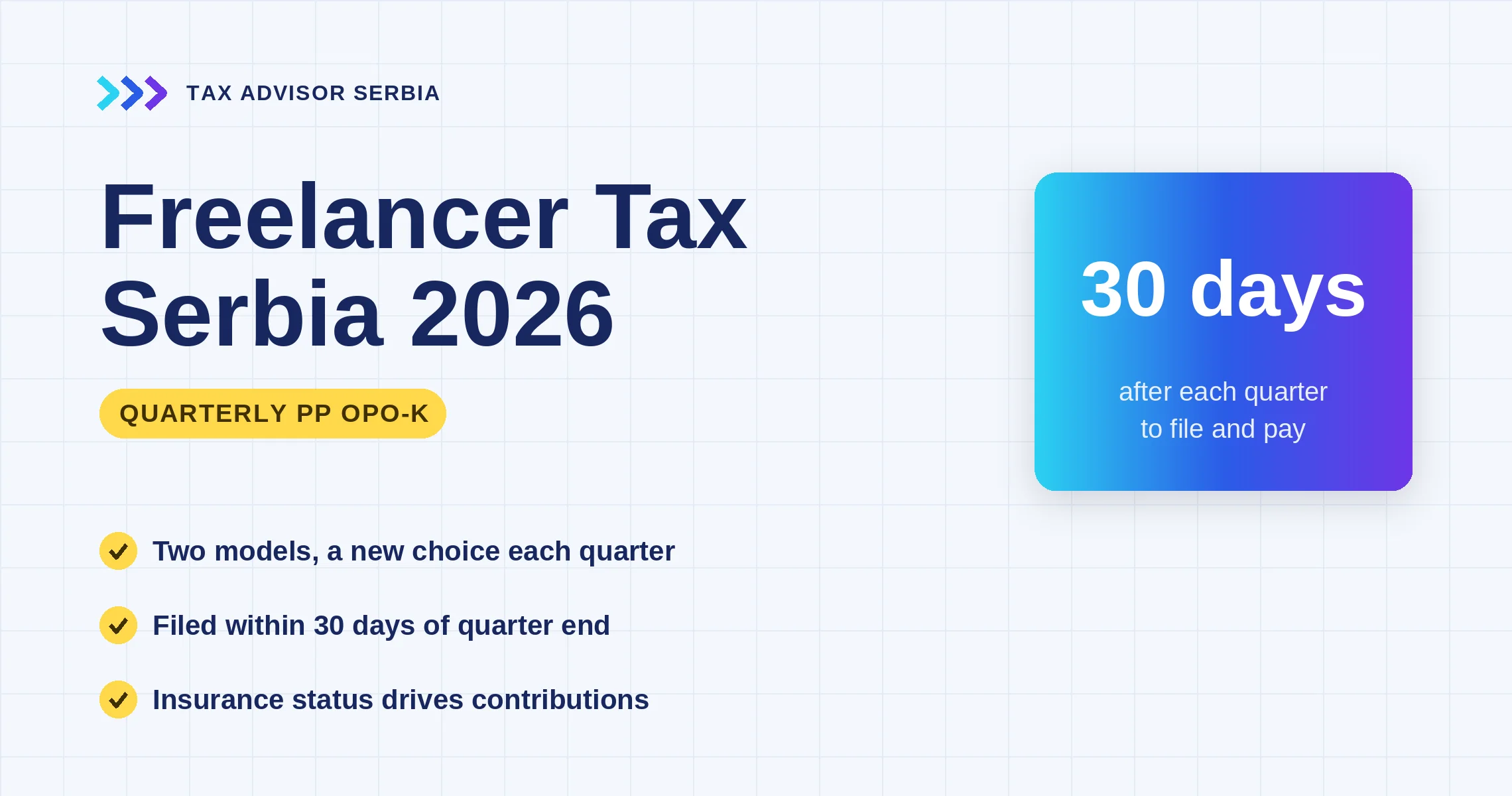
Freelancers in Serbia are often surprised by one key rule: if the payer does not withhold Serbian tax and social security, the individual must calculate and pay it themselves through a quarterly self-assessment filing.
This article explains the 2026 framework for taxing freelancer income typically earned from abroad (or from domestic payers who do not withhold), including:
- who is in scope,
- what “self-assessment” means in practice,
- the two alternative taxation models you can choose each quarter, and
- the deadlines and filing channels.
Important: This is a general guide. Social security contributions depend heavily on your insurance status and cross-border facts.

Who is considered a “freelancer” for tax purposes?
“Freelancer” is not a formal legal status in Serbia. In practice, the term is used for individuals who:
- earn income from foreign companies/individuals (or certain domestic payers),
- where the payer does not calculate and pay Serbian tax and contributions, and
- often perform work remotely (commonly from Serbia), under written or oral engagement.
This typically includes income paid under:
- copyright and related rights, and/or
- contracted work / services (“other income” categories).
What is “self-assessment” (self-taxation)?
Self-assessment means the recipient of income (the individual) must:
- calculate tax and (where applicable) social security contributions,
- file the prescribed tax return, and
- pay the assessed liabilities - on time.
Quarterly filing rule (PP OPO-K)
Freelancer income under this regime is reported quarterly, by filing PP OPO-K.
Deadline: within 30 days after the end of each quarter:
- Q1 (Jan–Mar) → 30 April
- Q2 (Apr–Jun) → 30 July
- Q3 (Jul–Sep) → 30 October
- Q4 (Oct–Dec) → 30 January (next year)
If the due date falls on a non-working day/holiday, it shifts to the next working day.
Two alternative models - and you can choose each quarter
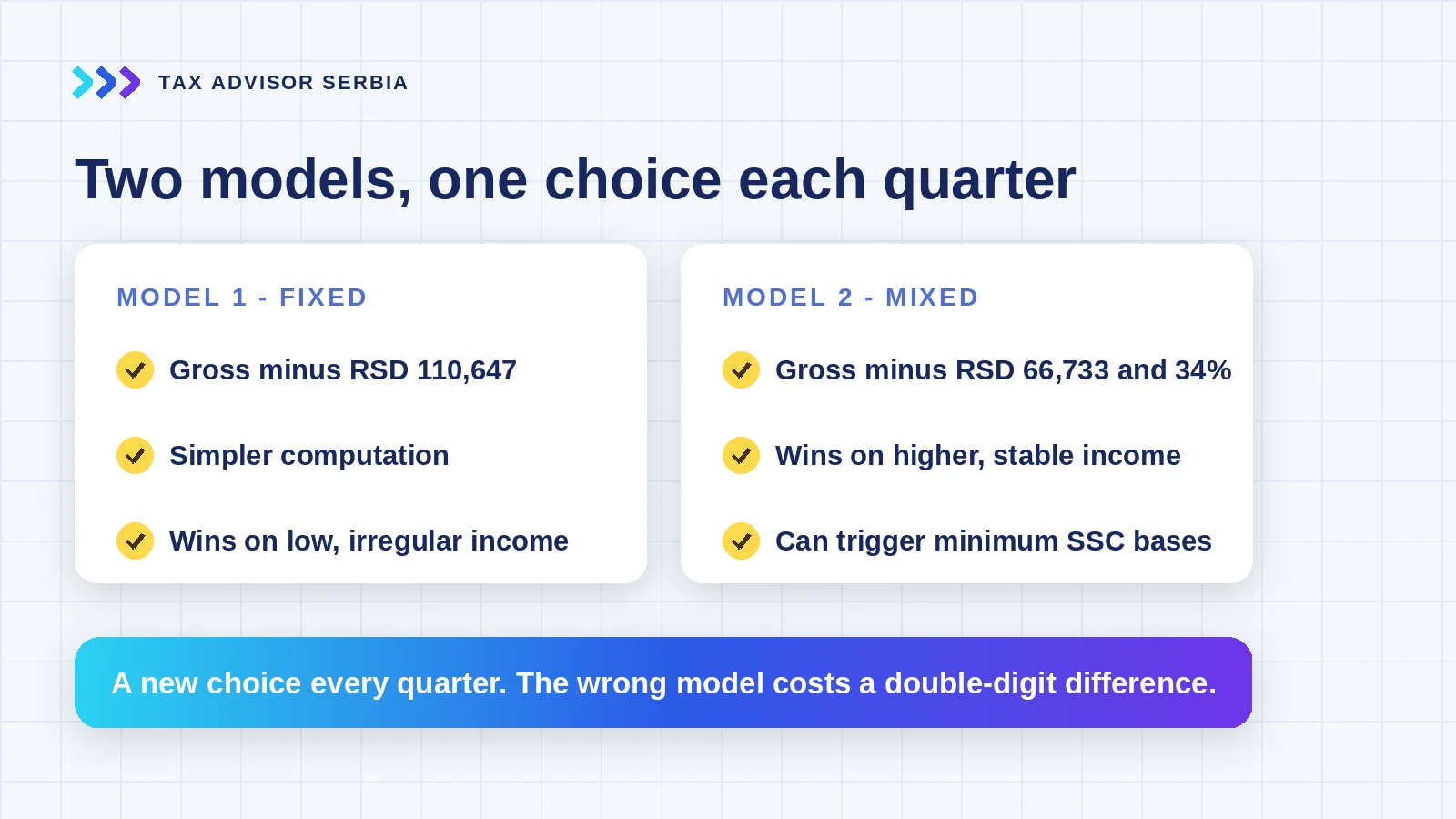
Serbia provides two models for determining the taxable base (and related contribution base mechanics). Key flexibility: you may choose Model 1 in one quarter and Model 2 in the next quarter - there is no requirement to keep the same model all year.
Standardized expenses (2026)
For 2026, the standardized expense amounts you deduct to arrive at the taxable base are:
Model 1 (fixed standardized expense)
Taxable base = Quarterly gross income – RSD 110,647
Model 2 (mixed standardized expense)
Taxable base = Quarterly gross income – RSD 66,733 – (34% × quarterly gross income)
If you earn both types of income in the same quarter (e.g., copyright + services) and they fall under this regime, standardized expenses are applied on the total, rather than separately duplicating the deduction.
When Model 1 vs Model 2 is usually better
A practical way to think about it:
Model 1 tends to be more favorable when:
- quarterly income is low or irregular,
- you want a simpler computation,
- you want to benefit from the larger fixed deduction.
Model 2 tends to be more favorable when:
- quarterly income is higher and more stable,
- the 34% standardized expense meaningfully reduces the base,
- your contribution mechanics (especially minimum bases) don’t eliminate the benefit.
Critical downside: for some taxpayers, Model 2 can trigger minimum social security contribution bases that effectively increase total cost even when tax looks lower. This is where many freelancers miscalculate.
Social security contributions: what actually drives the outcome
Whether you owe social security contributions (and which ones) depends on:
- where the work is performed (Serbia vs abroad),
- whether you are insured on another basis in Serbia (employment, entrepreneurship, pension, etc.),
- whether an applicable social security agreement exists (and how it applies).
Common practical outcomes:
- If you are insured on another basis, you may not owe health contributions again on freelancer income.
- If you are not insured elsewhere, you may owe:
- pension/disability contributions (PIO), and
- health contributions,
sometimes subject to minimum quarterly bases (depending on model).
Foreign tax paid: can you offset Serbian tax?
Serbia can allow a foreign tax credit in certain cases - but only if you have proper official proof of foreign tax paid (typically certified by the foreign tax authority), and documentation meets Serbian formalities (often including translation requirements). Without compliant proof, the credit often fails in practice.
How to file PP OPO-K (channels)
PP OPO-K is typically filed:
- electronically (via Serbia’s e-filing portals), and/or
- in paper form (where applicable under procedural rules).
Practical checklist (to avoid penalties and audits)
Before you file each quarter, confirm:
- correct income classification,
- optimal model selection for that quarter,
- clear health insurance status (whether health contributions apply),
- contracts/invoices/bank inflows are archived,
- foreign tax credit documents are compliant (if used),
- filing and payment are within the 30-day deadline.
How Tax Advisor Serbia Can Help
Freelancer compliance in Serbia is simple only on the surface. The model choice, insurance status, and cross-border documentation determine whether you slightly optimize - or materially overpay / underpay and trigger risk.
If you want, I can:
- confirm whether you fall under this regime,
- run a Model 1 vs Model 2 comparison for your real quarterly numbers, and
- prepare and submit PP OPO-K filings with a clean documentation package.
Get in touch here, or explore my other guides - such as Annual Personal Income Tax in Serbia: What Expats Need to Know and Newly-Settled Taxpayer Incentive in Serbia (2026): Eligibility, Minimum Salary Thresholds, and How to Secure It on Time.
Also, here you may check all my personal income tax and expat services.




.png)