

.svg)
US Serbia Tax Treaty: Why There Is No Treaty and What It Means (2026)

The United States and Serbia do not have a double tax treaty. Serbia has concluded treaties with more than 60 countries, including Germany, Austria, China, the United Kingdom and most of Europe, but the United States is not among them.
What does exist is often confused with a treaty. In 2019, Serbia and the United States signed a FATCA intergovernmental agreement, which Serbia has ratified and which is in force. FATCA is an information exchange framework: it tells the two tax administrations about your financial accounts. It does not reduce a single dinar or dollar of anyone's tax.
What a tax treaty would normally do, and what its absence means
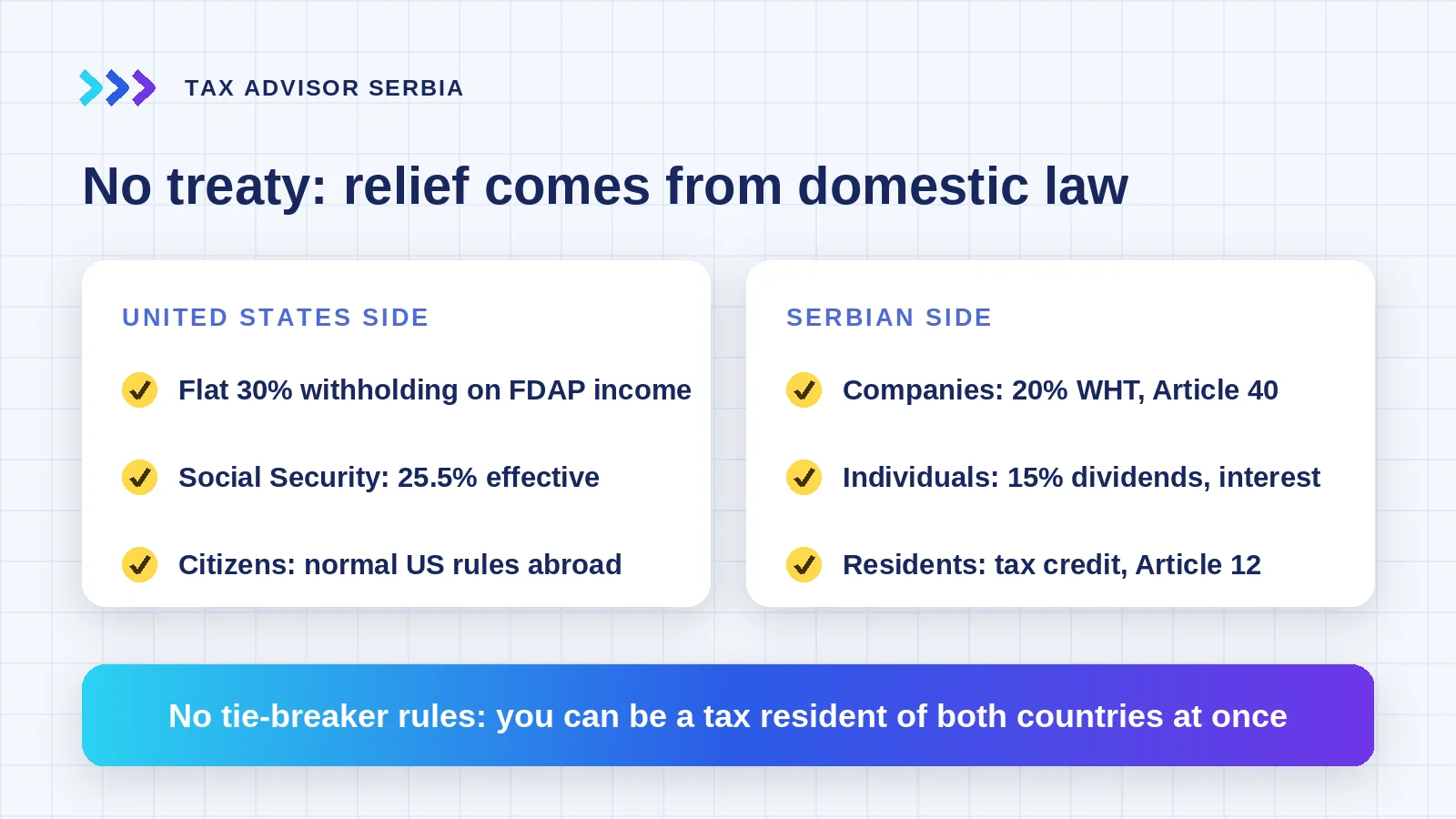
A double tax treaty typically does four things. It caps withholding tax rates on dividends, interest and royalties. It provides tie-breaker rules so you end up a tax resident of only one country. It allocates taxing rights over salaries, pensions and business profits. And it gives the two administrations a procedure for resolving disputes. Between the United States and Serbia, none of that machinery exists. Both countries apply their domestic rules in full, and any relief has to come from each country's own law rather than from an agreement between them.

Double taxation relief for US citizens residing in Serbia
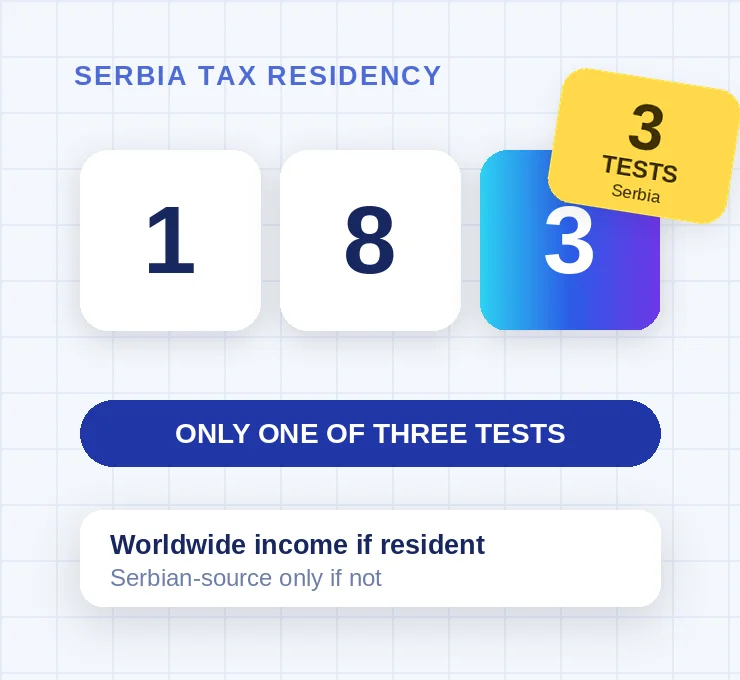
If you are a US citizen or green card holder living in Serbia, both countries claim you at the same time. The United States taxes its citizens on worldwide income wherever they live. Serbia taxes its residents on worldwide income as well, and whether you are a Serbian resident follows Serbia's own three tests, which I explain in my guide to Serbia tax residency.
Because there is no treaty, there are also no tie-breaker rules. US and Serbian residency are determined independently, each under its own domestic law, and you can be a tax resident of both countries at the same time. No form exists that resolves this for you.
Relief still exists. It just comes from domestic legislation on each side. On the Serbian side, Article 12 of the Personal Income Tax Law grants residents a tax credit for income earned in another country and taxed there: the foreign tax reduces the Serbian liability, but the credit cannot exceed the Serbian tax that would apply to that same foreign income. On the US side, the standard tools are the foreign tax credit and the foreign earned income exclusion. The order of operations matters: which country taxes first and which one credits depends on the type of income, and this is exactly where planning happens or fails.
Pensions and Social Security without a treaty
US pensions, IRA and 401(k) withdrawals and Social Security benefits received while living in Serbia are the questions I hear most often, and the ones a treaty would normally settle with a single article. Here, no article exists, so each country simply applies its own rules.
On the US side, the outcome depends on your status. US citizens remain taxed under the normal US rules wherever they live. Recipients who are not US persons face flat withholding at source: 30 percent on the taxable portion of pensions and annuities, while Social Security benefits are taxed on 85 percent of the amount at 30 percent, an effective 25.5 percent, unless a treaty provides otherwise. With Serbia, none does.
On the Serbian side, how a foreign pension is treated in the hands of a Serbian resident depends on the type of pension and on your specific circumstances, and the difference between treatments is significant. This is precisely the analysis I do in a paid consultation, so if a US pension is part of your life in Serbia, get in touch before it starts arriving, not after.
Social security contributions are a separate, second layer. The United States maintains totalization agreements with around 30 countries, and Serbia is not one of them. Without such an agreement, self-employed US citizens working from Serbia can face contribution obligations in both systems, with no mechanism to offset one against the other.
Payments between US and Serbian companies: withholding with no treaty relief
When a Serbian company pays a US company, Serbian withholding tax applies at the full domestic rate of 20 percent under Article 40 of the Corporate Income Tax Law. The 20 percent covers dividends, royalties, interest, lease payments for real estate and movable property in Serbia, and a defined set of services: market research, accounting and audit, and legal and business consulting services, regardless of where the services are provided or used. With a treaty, most of these rates would drop. Without one, 20 percent is the rate. The 20 percent rate is the corporate one. When the recipient of a Serbian payment is a US individual rather than a company, the Personal Income Tax Law applies instead: dividends and interest are taxed at 15 percent, while royalties, rental income and most other income types carry a 20 percent rate under their own rules. The logic is identical, though: these are the full domestic rates, and without a treaty there is nothing to reduce them.
A US tax residency certificate changes nothing here. Its entire purpose is to activate a reduced treaty rate, and there is no treaty to activate. The mechanics of withholding, the deadlines and the filing procedure are covered on my withholding tax services page.
In practice, the absence of a treaty shows up in contracts before it shows up in tax returns. If a US supplier insists on receiving the full invoiced amount, a gross-up clause shifts the withholding cost onto the Serbian payer. That detail is worth negotiating before signing, not after.
The mirror image applies to payments flowing from the United States to Serbia. US domestic law imposes a flat 30 percent withholding on US source dividends, interest, royalties and similar income paid to foreign persons, unless a treaty reduces it. For Serbian recipients, no reduction exists.
Dividend flows deserve their own walkthrough. The rates, the procedure and the paperwork are covered in my dividend tax guide.
Frequently asked questions
Is there a tax treaty between the United States and Serbia?
No. There is no income tax treaty in force between the two countries. Both apply their domestic tax rules in full, and relief from double taxation comes only from each country's own legislation.
How do you avoid double taxation as a US citizen in Serbia?
Through domestic mechanisms on both sides, coordinated correctly. Serbia grants its residents a tax credit for foreign tax paid on income earned abroad, capped at the Serbian tax on that same income under Article 12 of the Personal Income Tax Law. The US offers the foreign tax credit and the foreign earned income exclusion. The two returns have to be planned together, because the sequence determines the outcome.
Does the FATCA agreement count as a tax treaty?
No. The FATCA agreement between Serbia and the US, signed in 2019 and in force, deals with the exchange of financial account information between the two administrations. It provides no reduced rates and no protection from double taxation.
Do I need a Serbian tax residency certificate for US purposes?
For the US, no. The certificate exists to claim treaty benefits, and with the US there are none to claim. For the more than 60 countries Serbia does have treaties with, it remains essential. My residency guide explains how it works.
How does the missing treaty affect US pensions received in Serbia?
Both countries can tax them, each under its own rules. On the US side, flat withholding applies to recipients who are not US persons, while US citizens stay under the normal citizen rules. On the Serbian side, the treatment depends on the type of pension and your circumstances and has to be analyzed case by case. This is one of the questions I cover in a consultation.
I advise US citizens living in Serbia and US companies doing business here on the Serbian side of exactly these questions: residency, withholding, pensions, annual filings. Fixed fees, senior-only work, and direct coordination with your US tax preparer so the two returns fit together instead of fighting each other. Book a free 15-minute call.
Related reading: Serbia tax residency · Dividend tax in Serbia · Annual PIT

.avif)


.png)