

The Independence Test in Serbia: Nine Criteria for Preduzetnik and Paušalac
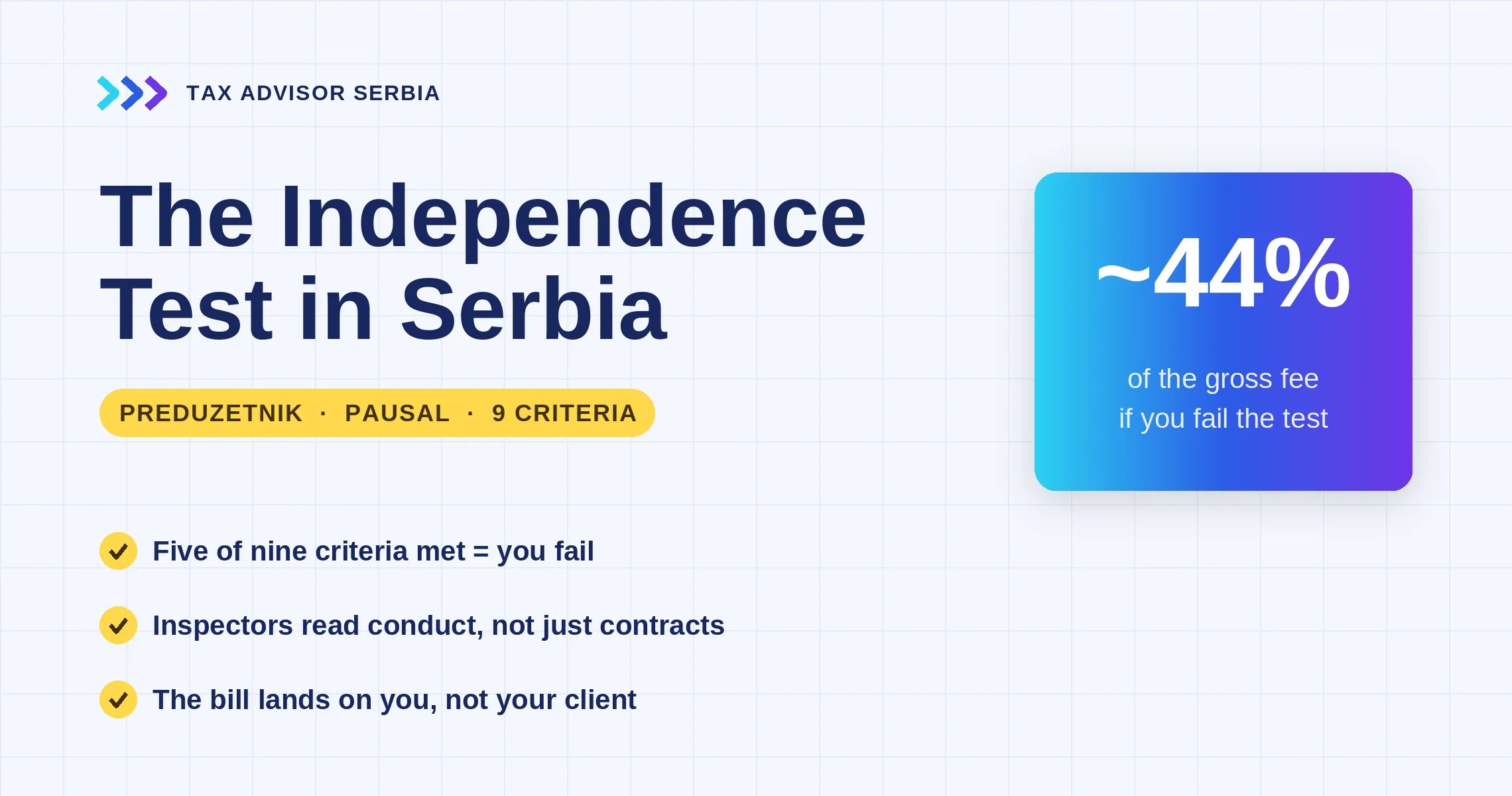
If you invoice one main client as a Serbian preduzetnik (registered entrepreneur), your tax position does not rest on the pausal limit or the VAT threshold. It rests on the independence test, known locally as the test samostalnosti. Fail it, and the fee you invoiced as business income is re-characterised as other income, with the bill landing on you, not on your client.
This article explains what the test checks, what it costs to fail, and what inspectors actually look at, based on how the test is applied in practice.
What the independence test is
The test sits in Article 85 of the Personal Income Tax Act and applies to paušalci (flat-rate entrepreneurs) and bookkeeping preduzetnici alike. It lists nine criteria describing an employment-like relationship with one principal. If at least five are met, the income from that principal stops being business income.
The nine, in plain language:
- Your working hours or leave effectively depend on the principal, or your fee is not reduced when you take time off
- The principal provides or designates your workspace
- The principal provides or organises your training
- You were engaged through a job advert or a recruiter
- The principal provides your basic tools or directs your work process
- At least 70% of your income comes from that one principal
- You work within the principal's own business activity and your contract places no business risk on you
- Your contract restricts you from serving other principals
- You worked 130 or more days for that principal in 12 months
Two things make the test stricter than it looks. It applies per principal, not per contract, and platforms or intermediaries that merely move the money are looked through: the test targets whoever actually orders and uses your work. And if it was foreseeable at the start of the cooperation that five criteria would be met, the result attaches to the whole period, not from the day someone noticed.

What failing the independence test costs
Re-characterised income is taxed as other income on the gross amount, with no deduction for costs: 20% tax plus pension and disability contributions of 24%, roughly 44% of every fee. On every EUR 1,000 received, that is about EUR 440, on top of whatever you already paid under your entrepreneur regime, which is not credited against it.
Late-payment interest runs at the central bank reference rate plus 10 percentage points, at the time of writing around 15.75% a year. The re-characterised income also enters your annual personal income tax base in full.
When your client is foreign, there is no Serbian withholding agent, so the obligation to self-assess and pay sits with you. In an audit you are the controlled taxpayer: the Tax Administration carries the burden of proving the criteria, but doubt caused by your own missing records can be resolved against you.
What inspectors actually look at
The common misconception is that the test is about the contract. Inspectors read the contract, then they read the relationship: e-mails, chat messages, meeting patterns, how your fee behaves when you are away, and who assigns your tasks day to day.
Some criteria are decided on wording alone: a non-compete or exclusivity provision keeps a criterion met even if nobody ever enforced it, and an e-mail agreeing exclusivity counts like a clause. Others are decided on conduct: a fixed monthly fee that never changes when you take days off, or absence messages that read like requests for approval, satisfy a criterion whatever the contract says. The combination of a fixed fee, one customer and a continuous engagement is exactly the pattern the official Instruction tells inspectors to look for.

The two mistakes that lose the independence test
The first mistake is fixing the wording and keeping the practice. An amended contract with unchanged conduct is new text over the same facts, and the facts win.
The second is collecting nothing until the audit. The file that decides the outcome is built from monthly records: invoices with specifications, correspondence showing who decides your method and timing, proof of your own equipment. None of it can be created convincingly two years later, and missing records work against you.
How I help
My independence test engagement has two parts. First, a review of your client contract, criterion by criterion, with the exact amendments needed for it to pass, written so your client can accept them. Second, the evidence file: for each criterion that matters in your setup, what to keep, who produces it and how often, so the proof exists as a routine long before anyone asks for it.
Fixed fee, signed written report, delivery within three working days, follow-up questions included.
Frequently asked questions
What is the independence test for a preduzetnik in Serbia?
It is a nine-criteria test in Article 85 of the Personal Income Tax Act that checks whether a registered entrepreneur genuinely works independently from one principal. If at least five criteria are met, income from that principal is re-characterised as other income and taxed at roughly 44% of the gross amount.
Does the independence test apply to paušalci or only to bookkeeping entrepreneurs?
Both. Article 85 names flat-rate and bookkeeping entrepreneurs alike, and the score is counted the same way.
Does having one client automatically mean I fail?
No. One client satisfies one criterion of nine, and failing requires five. It does, however, usually bring the structural criteria into play, which is why one-client setups should be tested deliberately rather than assumed safe.
I work through a platform like Deel. Does that protect me?
No. Intermediaries that move the money are disregarded, and the test is applied to the relationship with whoever actually orders and uses your work.
Can I just sign a better contract?
Wording fixes the criteria that are decided on wording. The rest are decided on how you actually work, which is why the contract review and the evidence routine come as one engagement, not two alternatives.
Is there a template for passing the independence test?
No universal template exists, because half of the criteria are decided on how you actually work, not on wording. What works is a contract aligned with the criteria plus a routine of monthly evidence; that is exactly what my engagement produces.
Working mostly for one client? I review your contract against all nine criteria and build the evidence plan that keeps your status defensible. Fixed fee, written report, reply within 24 hours. Get in touch.