


Working Remotely From Serbia for a Foreign Employer: Tax, Contributions and Filing (2026)
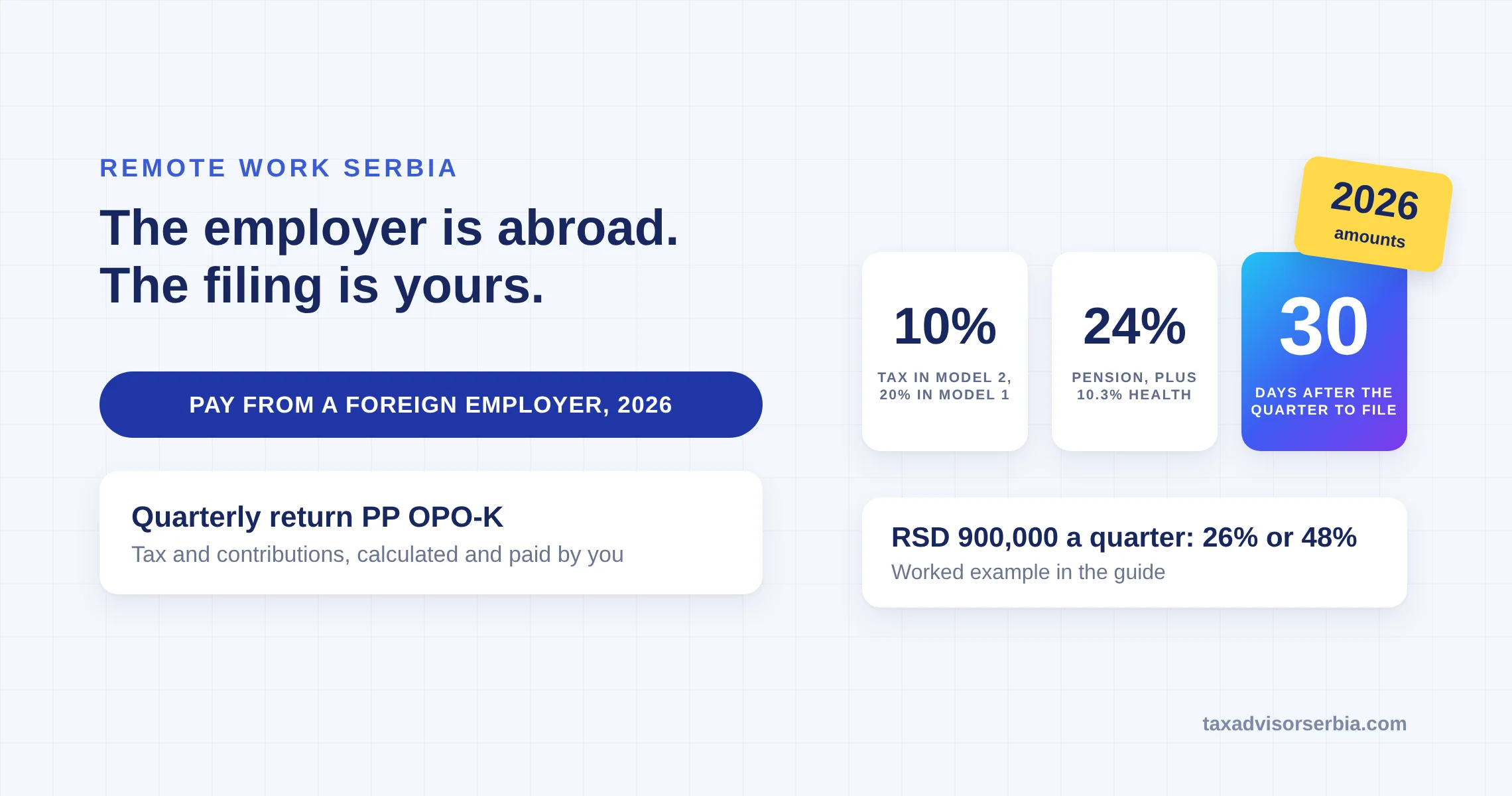
Short answer: If you are a Serbian tax resident and work from Serbia for an employer abroad that has no presence in Serbia, nobody runs Serbian payroll for you. Your pay is then generally taxed as freelancer income, whatever your foreign contract says. You calculate and pay the tax and the social security contributions yourself, on the quarterly return PP OPO-K, due within 30 days after the end of each quarter. Each quarter you choose one of two models: 20% tax after standardized costs of RSD 110,647, or 10% tax after RSD 66,733 plus 34% of the income. Pension contributions of 24% and, unless you are insured on another basis, health contributions of 10.3% come on top.
The rest of this guide shows who the rule applies to, what it costs on a typical monthly pay, how and when you file, what happens if tax was withheld abroad, and which other set-ups exist for the same work. For the wider picture, see my guide to taxes in Serbia for foreigners and companies.
Employed by a company abroad and living in Serbia? I prepare a written opinion on what Serbia taxes, which model costs less, the foreign tax credit and the returns you file. Send me your situation and I reply with a fixed-fee quote within 2 hours.
Who this applies to
- You are a tax resident of Serbia. If you are not sure, start with Serbia tax residency.
- You work for a company abroad that is not registered in Serbia and does not withhold Serbian tax. The label on the contract does not decide the tax treatment: it can be an employment contract or a contractor agreement.
- You do the work from Serbia.
It does not cover people who invoice a foreign company through their own business, as an entrepreneur or through a company: see four ways to tax foreign income in Serbia. It also does not cover employees sent by a foreign employer to work at a Serbian company, who have their own rule.
Why Serbia taxes it as freelancer income
Salary in the Serbian tax sense exists only with a Serbian employer. A foreign employer with no presence in Serbia cannot operate Serbian payroll, so nobody withholds tax and contributions from your pay. What matters is where the work is physically done and the substance of the arrangement, not the name of the contract.
The result is the regime usually called the freelancer regime: the person who receives the income calculates and pays the tax and contributions every quarter. My freelancer tax guide explains the regime step by step. This page covers what is specific to people on a foreign employer's payroll.
Digital nomads and short stays: the 90-day rule
If you are not a tax resident of Serbia and spend no more than 90 days here in a 12-month period, income you earn from a foreign principal that has no business activity in Serbia is exempt from Serbian income tax. This is the rule that short stays and most digital nomads rely on.
After 90 days the exemption no longer applies, and a non-resident is taxed in Serbia on income from work done in Serbia. A tax treaty with your home country can change that, typically for stays of up to 183 days. Once you become a Serbian tax resident, everything below applies to you.

How much you pay
One return covers everything you received from the employer in the quarter, and the amount you receive counts as gross income. You choose the model in each return, so the choice can change from one quarter to the next.
- Model 1. Taxable income is the quarterly income minus RSD 110,647. Income tax is 20% of taxable income. The pension contribution is 24% of taxable income, with no minimum.
- Model 2. Taxable income is the quarterly income minus RSD 66,733 and minus 34% of that income. Income tax is 10% of taxable income. The pension contribution is 24% of taxable income, calculated on at least RSD 153,891 a quarter.
- Health contribution, both models. 10.3% of taxable income, calculated on at least RSD 67,989 a quarter. It is not due if you are insured in Serbia on another basis.
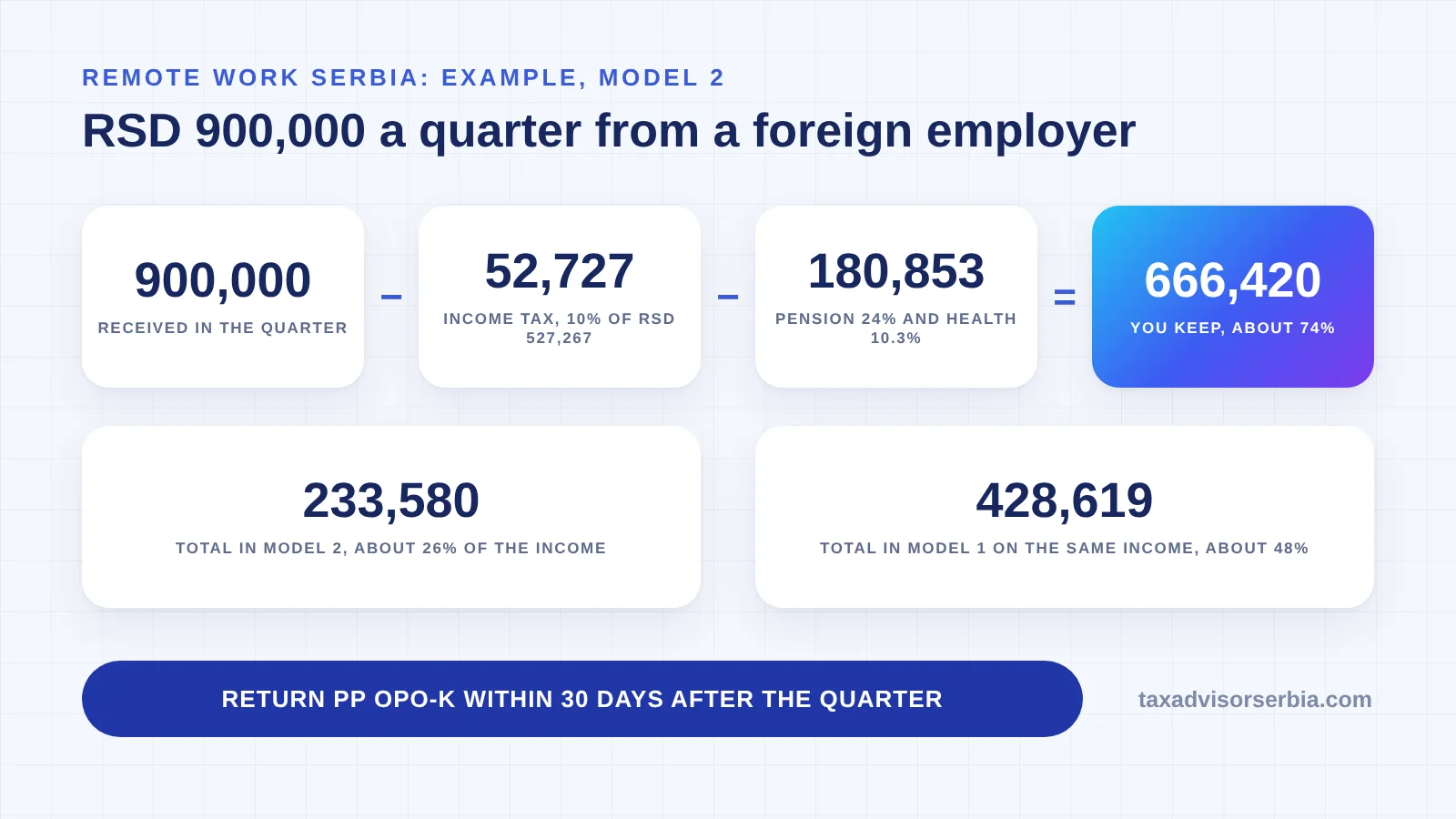
Example: pay of RSD 300,000 a month, RSD 900,000 in the quarter (about EUR 7,680 at RSD 117.2 per euro), not insured in Serbia on another basis, Model 2:
- Standardized costs: RSD 372,733
- Taxable income: RSD 527,267
- Income tax, 10%: RSD 52,727
- Pension contribution, 24%: RSD 126,544
- Health contribution, 10.3%: RSD 54,309
- Total for the quarter: RSD 233,580, about 26% of the income
- You keep: RSD 666,420
In Model 1 the same income costs RSD 428,619, about 48%. At this level of pay the choice of model is worth RSD 195,039 a quarter. My freelancer tax calculator shows both models for your own amount.
Want this checked on your real numbers? I confirm which model applies to you and what is due each quarter, and prepare the PP OPO-K return if you want it done for you. Send me your situation and I reply with a fixed-fee quote within 2 hours.
How and when you file: the quarterly return PP OPO-K
- Return: form PP OPO-K, one return for each quarter. You file it yourself, electronically through the Tax Administration's portal or on paper at the tax office for your place of residence.
- Deadline: within 30 days after the end of the quarter: 30 April, 30 July, 30 October and 30 January. If that day is not a working day, the deadline moves to the next working day. For the fourth quarter of 2026 that is 1 February 2027, because 30 January is a Saturday.
- Payment: tax and contributions are paid by the same date.
If tax was withheld abroad
Serbia gives a credit for income tax paid in another country, up to the Serbian tax on the same income, and only with a certificate from the tax authority of that country.
Check the treaty with the country in question before you file.
Social security in the employer's country
Whether insurance you keep in the employer's country removes the Serbian contributions depends on the social security agreement between Serbia and that country, and on the certificate issued under it. Without an agreement, or without the certificate, the Serbian contributions are due as described above.
Other ways to set up the same work
The freelancer regime is what applies when nothing else is set up. There are two other routes:
- Employment with a Serbian employer, for example the foreign company's own Serbian subsidiary. Then your pay is salary and the employer runs payroll. Only then can the relief for newly settled taxpayers apply, because it requires an employer that is resident in Serbia. See my guide to the newly settled incentive and the net salary calculator.
- Your own business: a paušal entrepreneur, an entrepreneur keeping books, or a company. The burden can be lower, but an entrepreneur still has to pass the independence test. See four ways to tax foreign income in Serbia and the independence test.
Which one fits depends on your numbers, your employer and your plans.
Three risks to know about
- Quarters that were never reported. They can be reported later on your own initiative, with interest. The longer the period, the larger the amount, so it is worth calculating before you decide how to proceed.
- Annual personal income tax. If your total income for the year is above the threshold, annual tax is due on top of the quarterly tax. See my annual income tax guide and calculator.
- A taxable presence for your employer. An employee who works from Serbia can, in some cases, create a permanent establishment of the foreign company in Serbia. It depends on what you do for the company and on the treaty.
Frequently asked questions
Do I have to pay tax in Serbia if I work for a foreign company?
Yes, if you are a Serbian tax resident: residents are taxed on income from Serbia and from abroad. Unless you register as an entrepreneur or set up a company, your pay is taxed as freelancer income, and you report and pay the tax and contributions yourself every quarter. If you are not a resident, income from work done in Serbia becomes taxable here once you stay more than 90 days in a 12-month period, unless a tax treaty says otherwise.
I have an employment contract, not a freelance contract. Does that change anything?
Generally not for Serbian tax. Salary in the Serbian tax sense exists only with a Serbian employer, so pay from an employer abroad that has no presence in Serbia goes into quarterly self-assessment, whatever the foreign contract says.
Is the amount I receive net or gross?
Gross. The standardized costs are deducted from the amount you receive, and you pay the tax and contributions out of it.
Which model should I choose?
The one that costs less in that quarter. You choose in each return, so check every quarter with the freelancer tax calculator.
Do I pay the health contribution if I am already insured?
Not if you are insured in Serbia through employment, your own business or a pension. Cover as a family member does not count. The pension contribution is due in both cases.
What changes in 2027?
The amounts in this guide are for 2026. The standardized costs and the contribution bases are adjusted every year, and I update this page when the 2027 amounts are published.
How I can help
I review your contract and payslips, confirm your residency and what Serbia taxes, compare the two models on your real quarterly numbers, and prepare the PP OPO-K returns if you want them done for you. Send me your situation and I reply with a fixed-fee quote within 2 hours.
Sources
- Law on Personal Income Tax (Zakon o porezu na dohodak građana), Articles 7, 8, 9b, 12, 12b, 13, 15v, 85, 86, 95 and 100a. Consolidated text, Legal Information System of the Republic of Serbia, in Serbian.
- Law on Contributions for Mandatory Social Insurance (Zakon o doprinosima za obavezno socijalno osiguranje), Articles 28, 35b, 36, 44 and 57. Consolidated text, Legal Information System of the Republic of Serbia, in Serbian.
- Rulebook on the tax return for self-assessed tax and contributions (Pravilnik o poreskoj prijavi o obračunatom porezu samooporezivanjem i pripadajućim doprinosima), Official Gazette RS, Nos. 15/2016, 20/2018, 27/2019, 67/2022, 21/2023 and 87/2025, form PP OPO-K. Legal Information System of the Republic of Serbia, in Serbian.
- Tax Administration, Frilenseri portal. In Serbian.
Get a fixed-fee quote within 2 hours