

Serbian Business Registers Agency (APR): Company Search, Extracts and How to Verify a Serbian Company

Before you sign with a Serbian supplier, pay an invoice to a new bank account or start talks to buy a company, ten minutes on public registers tells you whether the company exists, who can sign for it and whether its accounts are blocked. The main registers are free and official, but they work only in Serbian. This guide shows where to look, how to read what you find, and what the registers do not tell you.
What the Serbian Business Registers Agency (APR) is
The Serbian Business Registers Agency (APR, "SBRA" in English) keeps Serbia's business registers as public electronic databases: companies, entrepreneurs, financial statements, pledges, financial leasing, bankruptcy estates, beneficial owners and many others. Register data are public, so anyone can look them up online without proving a legal interest.
The catch for foreign users: APR states that its data search works only in Serbian. The search switches between Cyrillic and Latin script, not between Serbian and English.
How to search a company in the APR register
- Open APR's unified search at pretraga.apr.gov.rs/search ("Обједињена претрага").
- Choose what you search by: the registration number ("Матични број") or the business name ("Пословно име / Назив"). The APR search does not take the tax identification number (PIB).
- If you search by name, narrow the results by register (companies, entrepreneurs, bankruptcy estates and others) and by status.
- Click "Претражи" (Search). Each result shows the registration number, business name, type of entity and status. Click the registration number to open the full record.
Search by registration number whenever you have it. Business names are usually registered in Serbian Latin script, often with the legal form spelled out in Serbian, so a name search in English rarely finds the company.
What the company record shows
The record is grouped into sections. The ones that matter in a check:
- Basic data: business name, status, legal form, registration number and date of incorporation.
- Business data: PIB, core activity code and the company's current bank account numbers.
- Legal representatives and directors: who may sign for the company, and any limits on their powers.
- Members: who owns the company and in what shares, plus the registered share capital.
- Annotations, notices and bankruptcy documents: recorded events such as mergers, and documents on bankruptcy proceedings.
- Registrar decisions: every registration decision, grouped by year and downloadable. This is where you see when the director, the address or the owners changed.
- Published documents: founding acts, statutes and other documents the company had to publish.
Two checks are worth doing every time. Confirm that the person signing your contract is listed as a legal representative. And if an invoice asks you to pay to a new account, confirm that the account is on the company's record before you pay.

Company status: what each label means
The status is the first thing to read. The search filter lists these statuses, shown here in English with the Serbian label:
- Active ("Активан"): registered and not in any winding-up procedure.
- In liquidation ("У ликвидацији"): a voluntary winding-up. By law, the business name then carries the suffix "u likvidaciji". If you are dealing with a company in this status, my guide to liquidating a Serbian entity explains what happens to its tax obligations.
- In forced liquidation ("У принудној ликвидацији"): a winding-up started by the registrar on statutory grounds, for example when a company has not filed its annual financial statements for two consecutive years (Law on Companies, Article 546). The name carries "u prinudnoj likvidaciji".
- In bankruptcy ("У стечају"): court bankruptcy proceedings are open.
- Deleted ("Брисан"): struck off the register. The company no longer exists.
The filter also lists less common statuses ("Неактиван", "Забрана обављања делатности", "Ван надлежности Регистра", "Нерегистрован"). If you see anything other than Active, ask questions before you sign or pay.
Extracts: what is free and what is official
Searching, reading the record and downloading the published documents and registrar decisions cost nothing. What you pay for is an extract ("izvod"): a public document showing the registered data as they stand on the day it is issued. This is the document to use when someone asks for official proof of a company's registration.
- Fees from 1 January 2026: RSD 2,500 for a company extract and RSD 1,500 for an entrepreneur. APR's English fee pages still show older, lower amounts, so do not rely on them.
- Extracts for use abroad: ask your lawyer or accountant in Serbia to order the extract, and check with the foreign authority which translation or certification it accepts.
What the APR record does not show, and where to check it
VAT status. The Tax Administration keeps a public register of VAT payers, searchable by PIB on purs.gov.rs. If a Serbian invoice charges VAT, the issuer should be in that register. My guide to VAT registration in Serbia explains who has to register.
Blocked accounts. When a company does not pay a debt that is being collected by force, the National Bank of Serbia (NBS) blocks its registration number, which blocks all its bank accounts. Banks may not open new accounts for it. The NBS search of debtors in enforced collection takes the registration number or the PIB and shows whether the company has unpaid obligations and how many days its accounts were blocked over the last five years. The NBS states that these data are official and can be used without a separate certificate.
Financial statements. APR's Register of Financial Statements publishes companies' annual statements, and you can read them online for free. Annual statements are due by 31 March of the following year (Law on Accounting, Article 44). A company that had no business transactions and has no assets or liabilities in its books files a statement of inactivity instead, by the same date. A company with nothing published for last year is either new, late or a reason to ask why.
Beneficial owners. The Central Records of Beneficial Owners, also kept by APR, show who ultimately owns or controls the company. Under the law in force since 1 October 2025, identification numbers and supporting documents are open only to those with a justified interest.
Pledges, leasing and bankruptcy. APR's pledge and financial leasing registers show whether the company's assets are pledged or leased. The Agency for Licensing of Bankruptcy Administrators publishes a list of bankruptcy proceedings with the court, the case number and the administrator.
A 10-minute check before you sign
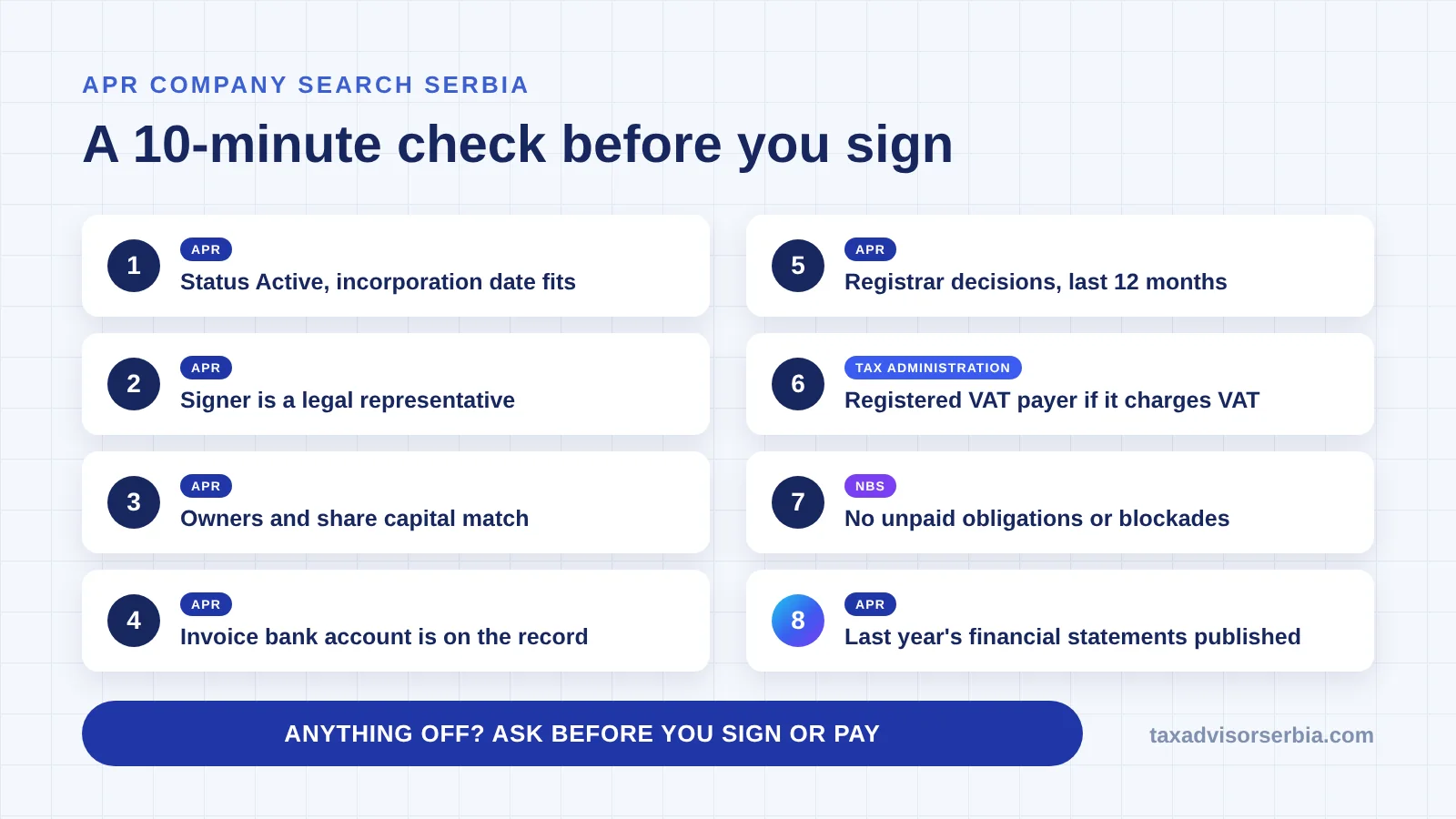
- APR: status is Active, and the date of incorporation fits the story you were told.
- APR: the person signing is a legal representative.
- APR: the owners and the share capital match what you were told.
- APR: the bank account on the invoice is on the record.
- APR: registrar decisions from the last 12 months. Repeated changes of director, address or owners deserve a question.
- Tax Administration: the company is a registered VAT payer if it charges VAT.
- NBS: no unpaid obligations and no recent blockades.
- APR: last year's financial statements are published.
When a register check is not enough
The registers confirm who the company is and whether it is in trouble today. They do not show taxes under audit, VAT or payroll exposures, or transfer pricing risks that become yours if you buy the company. Before an acquisition or a large long-term contract, I run a tax review of the Serbian company: open tax years, VAT, payroll and transfer pricing, with exposures quantified in euros. Fixed fee, proposal within 24 hours. See how my tax due diligence works.
If you are still setting up your own company in Serbia, start with my guide to company registration in Serbia, and for the wider picture, doing business in Serbia.
Frequently asked questions
Is the APR company search free?
Yes. Searching, viewing a company's record and downloading its published documents are free. An official extract is paid: RSD 2,500 for a company from 1 January 2026.
Can I search the APR register in English?
No. APR states that its data search works only in Serbian. The search switches between Cyrillic and Latin script.
Can I search the APR register by PIB?
Not in APR's unified search, which takes the registration number or the business name. The Tax Administration's searches and the NBS debtor search accept the PIB.
What is the difference between the registration number and the PIB?
The registration number ("matični broj") identifies the company in the register and is assigned by the Statistical Office. The PIB is the tax identification number, assigned at registration. Both appear on the APR record.
How do I check whether a Serbian company's account is blocked?
Use the NBS search of debtors in enforced collection with the company's registration number or PIB. It shows unpaid obligations and the blockade history for the last five years.
Does a clean APR record mean the company has no tax problems?
No. The register shows status, owners and representatives. Tax debts under audit and other exposures only show up in a tax review of the company's books and filings.