


Permanent Establishment in Serbia: When a Foreign Company Becomes Taxable Here (2026)
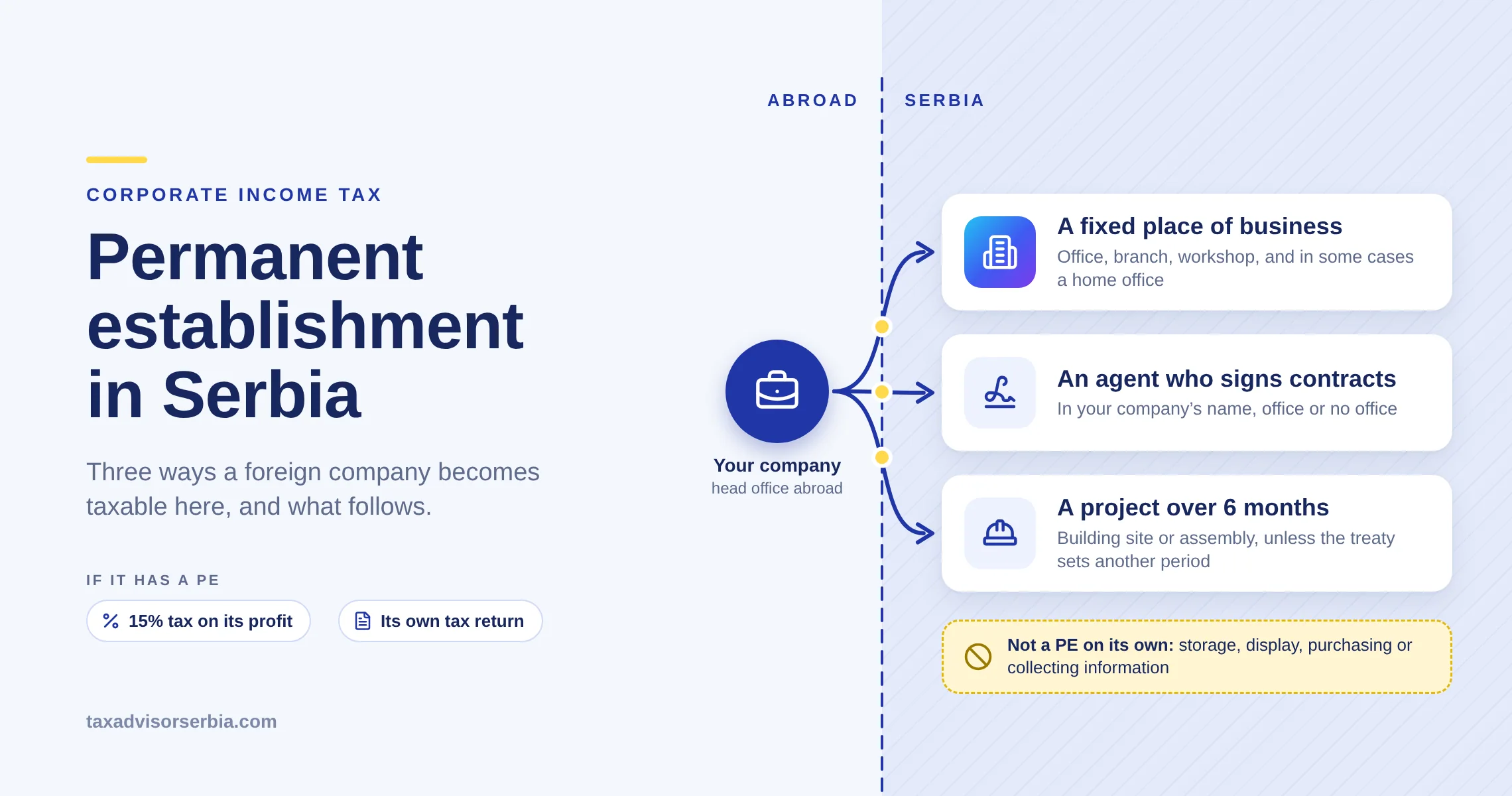
Short answer: A foreign company has a permanent establishment (PE) in Serbia when it carries on its business here through a fixed place of business, through a person who has and uses the authority to conclude contracts in its name, or through a construction or assembly project that lasts more than six months. The profit attributable to the PE is taxed in Serbia at 15%, and the PE files its own tax balance and corporate income tax return. A double tax treaty with the company's home country can change these tests, and where it applies, it takes precedence over Serbian law.
This guide is for foreign companies with people or activities in Serbia: an employee working from home here, a country manager or sales agent, a founder who has moved to Belgrade, or a team on a project. It explains what counts as a PE, which situations usually create one and what follows. If you are still choosing how to enter Serbia, see my guide to a DOO, a branch or a representative office.
Someone works for your company in Serbia? I prepare a signed opinion on whether your company has a permanent establishment here, with the treaty position and what to change in roles and contracts. Send me your situation and I reply with a fixed-fee quote within 2 hours.
What counts as a permanent establishment under Serbian law
Serbian corporate income tax law defines a PE as any fixed place of business through which a non-resident company carries on its business. The law lists, in particular:
- a branch,
- a plant,
- a representative office,
- a place of production, a factory or a workshop,
- a mine, a quarry or another place of extraction of natural resources.
The list is not closed: any other fixed place through which the business is carried on can be a PE as well. Two further rules extend the definition:
- Construction and assembly. A building site or a construction or assembly project is a PE if it lasts more than six months. The rule also covers one of several projects carried out at the same time, and several projects that follow each other without a break.
- Agents. If a person representing the company has, and exercises, the authority to conclude contracts in the company's name, the company has a PE for the activities that person carries out for it.
Two rules take activities out of the definition:
- Independent intermediaries. There is no PE when the company does business in Serbia through a commission agent, a broker or another intermediary acting in their own name.
- Preparatory and auxiliary activities. Storing, displaying or delivering the company's goods, holding goods for processing by another company, a place used only to purchase goods or collect information, and other preparatory or auxiliary activities do not create a PE.
When a double tax treaty changes the answer
Serbian law applies only to the extent that a double tax treaty does not provide otherwise. Even so, a company that works in Serbia through a place that is a PE under Serbian law but not under the treaty still files a tax balance and a tax return here. Treaties follow the same logic, but the wording differs from treaty to treaty, for example the period after which a construction project becomes a PE.
Serbia has also signed the multilateral instrument (MLI) and chose its provisions that tighten the PE rules on contract-concluding agents and on preparatory or auxiliary activities, including activities split into separate pieces. They apply only under treaties where the other country made the same choice. So the first step in any PE question is to read the treaty with the company's country, as modified by the MLI.

Situations that usually raise the question
In practice the question comes up in six situations:
- An employee who works from home in Serbia. Serbian law has no special rule for home offices, so the general test applies: is the home a fixed place through which the company carries on its business. The OECD's 2025 update to the Commentary on its Model Tax Convention gives a practical test. A home used for less than 50% of the person's working time over any 12-month period is generally not a place of business of the employer. Above that, it depends on the facts, mainly on whether there is a commercial reason for the work to be done in Serbia. Serbia is not an OECD member and the Commentary is guidance, not law, but it is widely used to read treaties based on the OECD model.
- A country manager or sales agent. The risk sits in the contracts. A person in Serbia who concludes contracts in the company's name creates a PE under Serbian law, office or no office. Under some treaties, as modified by the MLI, it can be enough that the person habitually plays the principal role leading to contracts that the company then concludes without material changes.
- A founder or director who has moved to Serbia. Two questions arise. The first is a PE, if the company's business is carried on through the founder's place of work here. The second is residence: a company that has its place of effective management and control in Serbia is a Serbian resident and pays Serbian tax on its worldwide profit. Where a treaty applies, it decides which country's residence prevails. The founder's own tax residency is a separate question, covered in my guide to Serbia tax residency.
- A project team. Installation, construction or assembly work in Serbia becomes a PE after six months under Serbian law, or after the period set in the treaty.
- A representative office. It is not a PE as long as its work stays preparatory or auxiliary, such as market research and promotion. Once its staff negotiate and conclude contracts, it can become one.
- A person hired through an employer of record. The employer of record employs the person and runs Serbian payroll. That settles payroll, not the PE question, which still depends on what the person does for your company.
Not sure where your set-up stands? I review the roles, contracts and treaty for your company and tell you in a signed opinion whether there is a permanent establishment and what to change. Send me your situation and I reply with a fixed-fee quote within 2 hours.

What follows if your company has a PE in Serbia
- Corporate income tax at 15% on the profit attributable to the PE.
- Its own tax balance and tax return. They are filed within 180 days after the end of the tax period, and tax is paid during the year in monthly advances, by the 15th of the following month. A PE without its own books must keep records of all its income and expenses.
- Transfer pricing with the head office. Transactions between the PE and its foreign head office fall under the Serbian transfer pricing rules, and interest on a loan from the head office and royalties paid to it are not deductible in the PE's tax balance. See my transfer pricing guide.
- Past years. If a PE existed before anyone noticed, the tax for past periods can be assessed within the five-year limitation period, with late-payment interest.
Payroll and VAT follow their own rules and are not covered here. For an employee of a foreign company without Serbian payroll, see my guide to working from Serbia for a foreign employer.
Managing PE risk: what I review in a signed opinion
- Roles. What each person does for your company in Serbia, and who negotiates and signs.
- Contracts and approvals. Employment, agency and customer contracts, and how deals are approved and concluded.
- Time and place. Working time in Serbia, home offices and the length of each project.
- Treaty and MLI. The rules that apply between Serbia and your company's country.
- The set-up. What to change in roles and contracts, or whether a branch or a Serbian company fits better. See DOO, branch or representative office.
Frequently asked questions
What is a permanent establishment in Serbia?
A fixed place of business through which a foreign company carries on its business in Serbia, such as a branch, an office or a workshop. A construction or assembly project of more than six months, and a person who concludes contracts in the company's name, also create one. The profit attributable to it is taxed in Serbia.
Does a remote employee create a permanent establishment in Serbia?
Not automatically. It depends on whether the home is a place through which the company carries on its business, on what the employee does, in particular whether they conclude contracts, and on the treaty. Under the OECD's 2025 guidance, a home used for less than half of the working time over 12 months is generally not a place of business.
When does a construction project become a permanent establishment?
Under Serbian law, when it lasts more than six months. Projects that follow each other without a break are counted together. The treaty with the company's country may set a different period, and the treaty takes precedence.
How is a permanent establishment taxed in Serbia?
At 15% on the profit attributable to it. It files a tax balance and a tax return within 180 days after the end of the tax period and pays monthly advances during the year.
Can a foreign company managed from Serbia become a Serbian taxpayer?
Yes. A company that has its place of effective management and control in Serbia is a Serbian resident for corporate income tax and is taxed here on its worldwide profit. A treaty may decide which country's residence prevails.
Does an employer of record remove the permanent establishment risk?
Not by itself. It takes care of employment and payroll. Whether your company has a PE still depends on what the person does for it.
How I can help
For a signed opinion on your company, or a country entry memo before you enter Serbia (legal form, VAT, withholding tax and transfer pricing), send me your situation and I reply with a fixed-fee quote within 2 hours.
Sources
- Law on Corporate Income Tax (Zakon o porezu na dobit pravnih lica), Articles 2, 3, 4, 5, 20, 39, 60, 63 and 67. Consolidated text, in Serbian.
- Law on Tax Procedure and Tax Administration (Zakon o poreskom postupku i poreskoj administraciji), Articles 75 and 114. Consolidated text, in Serbian.
- OECD, MLI position of Serbia, Articles 12 and 13.
- OECD, The 2025 Update to the OECD Model Tax Convention, Commentary on Article 5.
- Ministry of Finance, double tax treaties of the Republic of Serbia.
Get a fixed-fee quote within 2 hours