

DOO, Branch or Representative Office in Serbia (2026): The Tax Differences
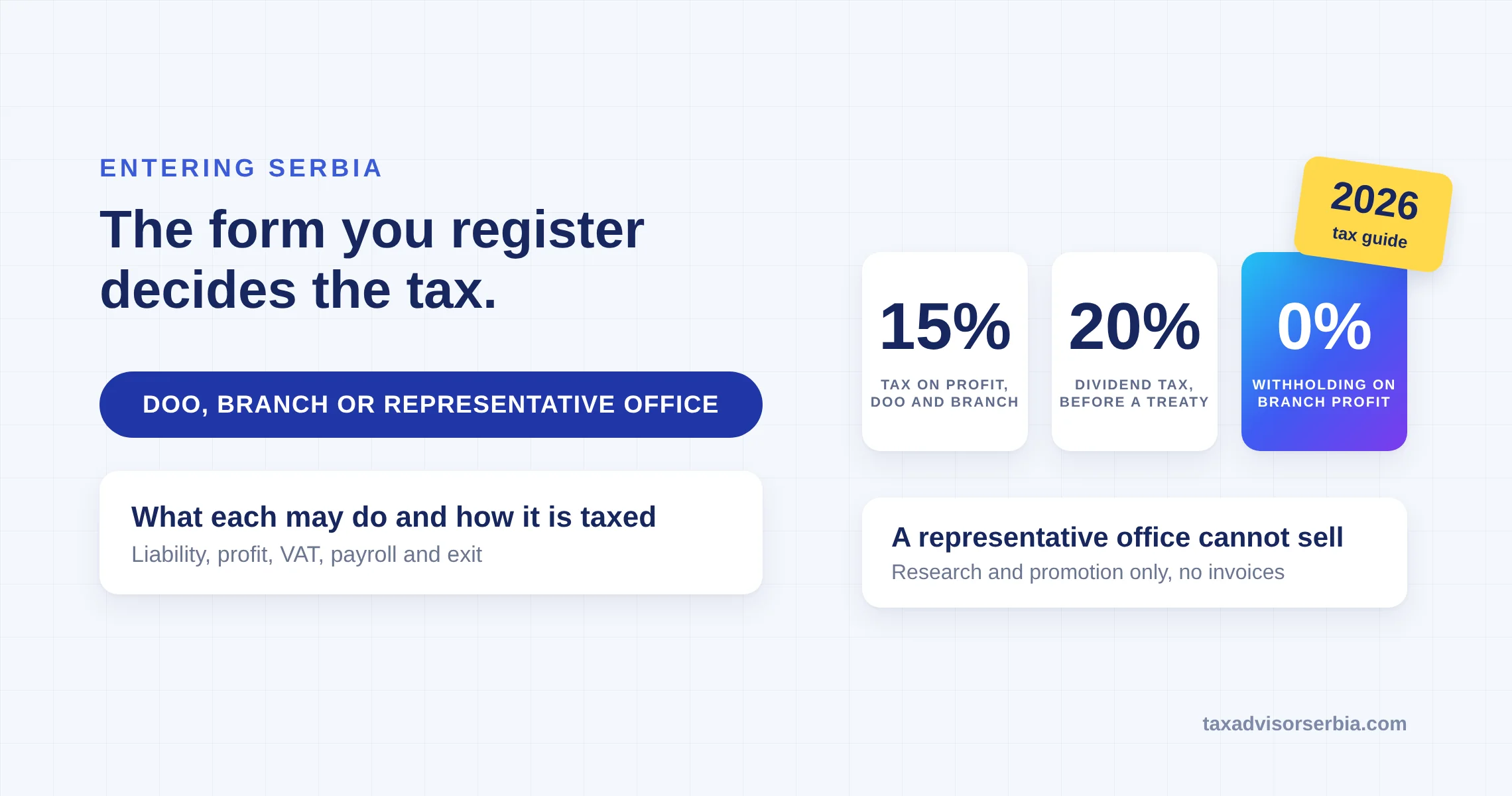
Short answer: A foreign company can enter Serbia through a limited liability company (DOO), a branch or a representative office. A DOO is a separate Serbian company, the usual form of a subsidiary: the risk stays in Serbia, profit is taxed at 15%, and dividends to the parent carry 20% withholding tax unless a tax treaty lowers it. A branch is the foreign company itself: it pays the same 15% on its Serbian profit and sends the rest to the head office without withholding tax, but the parent answers for everything the branch does. A representative office may only prepare the ground. It cannot sell or issue invoices.
This guide compares the three forms on the points that cost money later: liability, tax on profit and on taking it home, dealings with the parent, VAT, payroll and exit. The registration steps are in my guide to company registration in Serbia, and the budget is in my guide to the cost of setting up a company in Serbia.
Choosing the form for Serbia? Before anything is registered, I compare the options on your numbers in a short written country entry memo: tax on profit and on sending it home under your treaty, payments to the parent, VAT and payroll. Send me a short description and I reply with a fixed-fee quote within 2 hours.
The three forms at a glance
- DOO (limited liability company). A Serbian legal entity owned by the foreign company. It may carry on any lawful business. The owner is not liable for its debts, with narrow exceptions. It is taxed in Serbia on its worldwide profit.
- Branch (ogranak). A registered part of the foreign company, with no legal personality of its own. It may carry on business, but always in the name and for the account of the foreign company, which is liable for all of its obligations. Serbia taxes the profit earned through it.
- Representative office (predstavništvo). A registered part of the foreign company that may only do preliminary and preparatory work for the parent's deals. It can sign contracts for its own running, such as a lease or employment contracts, and nothing else.
All three are entered in the register of the Serbian Business Registers Agency (SBRA, "APR" in Serbian). The state fee is the same for each: RSD 8,000, about EUR 70.

DOO: a Serbian taxpayer in its own right
DOO stands for društvo s ograničenom odgovornošću, the Serbian limited liability company. It is the form the large majority of foreign investors choose.
- Liability. The parent is not liable for the DOO's obligations. The protection is lost if the owner abuses it, for example by using company assets as its own. Tax law adds a rule that parent companies rarely expect: a member holding 50% or more of the shares is jointly liable for the company's unpaid corporate income tax.
- Tax on profit. A DOO is a Serbian tax resident and pays corporate income tax at 15% on its worldwide profit.
- Profit to the parent. Profit goes to the parent as a dividend, with 20% withholding tax. Double tax treaties usually cut the rate to 5-15%, but only if the company holds the parent's certificate of tax residence before the payment. My guide to dividend tax in Serbia covers the documents.
- Payments to the parent. Service fees, interest and royalties are deductible if they are at arm's length and documented, and several of them carry withholding tax of their own. Every transaction with the parent is reported under transfer pricing rules.
- Capital. The minimum share capital is RSD 100.
Branch: the foreign company itself, taxed in Serbia
A branch is not a company. A contract signed by the branch is a contract of the foreign company, and the foreign company is liable for it without limit. That is the main reason most investors prefer a DOO.
- Tax on profit. For tax purposes a branch is a permanent establishment of the foreign company. It keeps its own books, files its own tax balance sheet and tax return, and pays 15% on the profit earned through it.
- Profit to the head office. Moving after-tax profit to the head office is not a dividend, and Serbia charges no withholding tax on it.
- Dealings with the head office. The advantage comes with limits. Interest on a loan from the head office and royalties paid to the head office are not deductible in the branch. Other dealings with the head office fall under transfer pricing rules, as if the two were separate companies.
- Income from Serbian customers. A Serbian company that pays the branch does not withhold tax, because the income is taxed in the branch's own return.
- VAT. A branch registers for VAT under the same rules as a Serbian company. What the head office supplies to Serbian customers directly stays outside the branch and has its own VAT treatment.
- Payroll. A branch can employ people in Serbia and runs Serbian payroll for them.
- Limits in practice. Some regulated activities and procedures are open only to companies registered in Serbia. After registration, the branch must enter its beneficial owners in the central register within 30 days, and the branch representative has to sign that filing electronically in person.
- Closing. A branch is deleted from the register in one step, with a final tax return due within 60 days. A DOO has to go through liquidation, which takes months and has its own series of tax filings.
Representative office: presence without sales
A representative office suits a company that wants people on the ground before it has anything to sell here: market research, promotion, contact with partners and authorities. It cannot conclude sales contracts, deliver goods or services, or issue invoices to customers.
- Corporate income tax. As long as the work stays preparatory or auxiliary, the office is not a permanent establishment and the foreign company has no Serbian profit to tax. The risk is in what people do, not in what is registered: once staff in Serbia negotiate and conclude contracts in the company's name, the company can have a permanent establishment here, with a tax return to file and profit to attribute to it.
- Payroll. The office is an employer. It registers its staff, runs payroll and withholds salary tax and contributions like any Serbian employer.
- VAT. The office makes no supplies, so it charges no VAT. The VAT on its own costs is a cost, unless the foreign company qualifies for a refund as a foreign taxpayer.
The same profit, two ways home
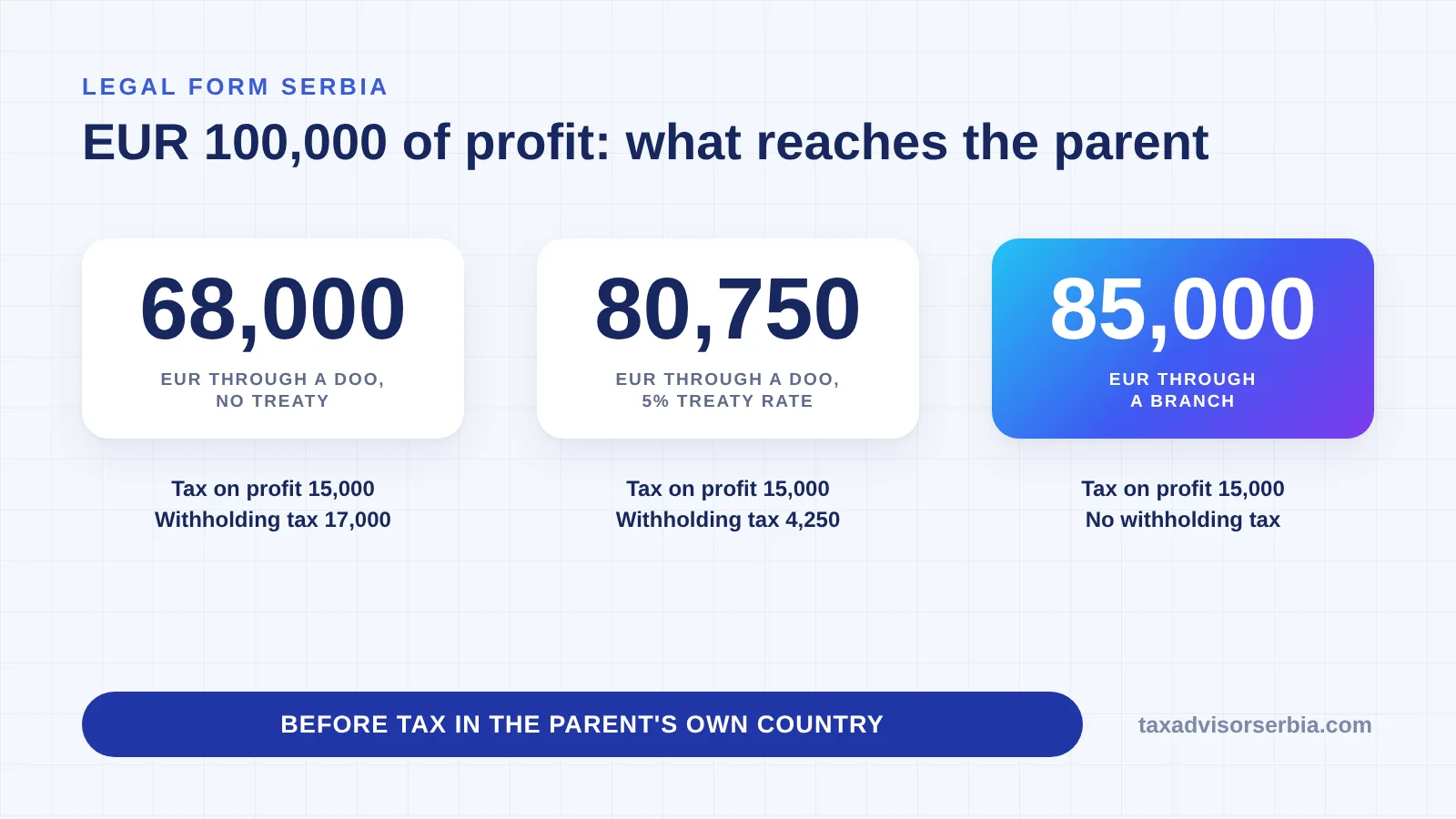
A Serbian operation earns a taxable profit of EUR 100,000, and all of it goes to the foreign parent.
- DOO, no treaty: corporate income tax EUR 15,000. The dividend of EUR 85,000 bears 20% withholding tax, EUR 17,000. The parent receives EUR 68,000.
- DOO, treaty rate of 5%: corporate income tax EUR 15,000, withholding tax EUR 4,250. The parent receives EUR 80,750.
- Branch: corporate income tax EUR 15,000 and no withholding tax on the transfer. The head office receives EUR 85,000.
The example stops at the Serbian border on purpose. How the parent's own country taxes a dividend or the profit of a foreign branch, whether Serbian tax is credited there, and what the limits on head office charges cost the branch can each reverse the result. That calculation is different for every group.
Five questions that decide the form
- Will you sell in Serbia? If yes, a representative office is out.
- Where should the risk stay? A DOO keeps it in Serbia. A branch puts the parent on every contract.
- How will money move between Serbia and the parent? Dividends and treaty rates on one side. No withholding tax on profit, but non-deductible head office interest and royalties, on the other.
- Will you hire or relocate senior people? The relief for newly settled employees, a 70% lower salary tax base for five years, needs a qualifying employer in Serbia. A DOO or a branch can be one, but not an employer that is related to the employee's previous employer. Settle that before the contracts are signed.
- How long will you stay? A project with an end date points to a branch, a permanent business to a DOO.
If your answers point in different directions, send me your situation. I reply with a fixed-fee quote within 2 hours.
Cost and timing
- State fee: RSD 8,000 for a DOO, a branch or a representative office.
- Legal fees: around EUR 800 for a DOO with a founder abroad. A branch is in the same range, roughly EUR 700 to 1,100 depending on what is included.
- Timing: SBRA decides within five working days of a complete application. With documents prepared abroad and a bank account to open, plan for two to four weeks for a DOO and four to six weeks for a branch.
- Running cost: a branch keeps full books and files financial statements like a company, so bookkeeping is not cheaper than for a DOO.
The full first-year budget for a DOO is in my guide to the cost of setting up a company in Serbia.
Can you change the form later?
Not with a simple filing. A branch cannot be converted into a DOO. You found a new company, move the business to it, with its contracts, assets and people, and delete the branch. Each step has tax consequences, starting with VAT and the tax on any gain. A representative office that wants to start selling faces the same exercise. Choose the form for the business you expect in three years, not for the first six months.
Frequently asked questions
What does DOO mean in Serbia?
DOO stands for društvo s ograničenom odgovornošću, a limited liability company, comparable to an LLC, a GmbH or a Ltd. One founder is enough, the founder can be a foreign company or individual, and the minimum share capital is RSD 100.
Is a branch in Serbia a separate legal entity?
No. A branch has no legal personality. It acts in the name and for the account of the foreign company, which is liable for its obligations without limit.
Does a branch pay withholding tax when it sends profit to the head office?
No. The branch pays 15% corporate income tax on its profit, and the transfer of the after-tax profit to the head office is not subject to Serbian withholding tax. How that profit is taxed at home depends on the head office's country.
Can a representative office issue invoices in Serbia?
No. A representative office may only do preliminary and preparatory work for the foreign company and sign contracts for its own running. A company that wants to sell in Serbia needs a branch or a DOO.
Does a representative office pay tax in Serbia?
It pays salary tax and social security contributions for its employees. It has no corporate income tax as long as its work stays preparatory or auxiliary.
Can a foreign company employ people in Serbia without registering anything?
It can sign the contract, but it cannot run Serbian payroll. The employee then reports and pays the tax and contributions personally, and the company should check whether that person creates a permanent establishment for it in Serbia. See my guide to working from Serbia for a foreign employer.
Sources
- Law on Companies (Zakon o privrednim društvima), Articles 18, 139, 145 and 567 to 577
- Law on Corporate Income Tax (Zakon o porezu na dobit pravnih lica), Articles 2 to 5, 20, 34, 39, 40, 40a, 60 and 111
- Law on Personal Income Tax (Zakon o porezu na dohodak građana), Articles 15v and 99
- Law on Value Added Tax (Zakon o porezu na dodatu vrednost), Articles 8, 33, 38 and 53
- Law on Accounting (Zakon o računovodstvu), Article 4
- Serbian Business Registers Agency (APR), fees for companies
- Ministry of Finance, double tax treaties of the Republic of Serbia
Get a fixed-fee quote within 2 hours