

VAT Exemption for Export of Goods: Conditions, Deadlines and Practice in Serbia
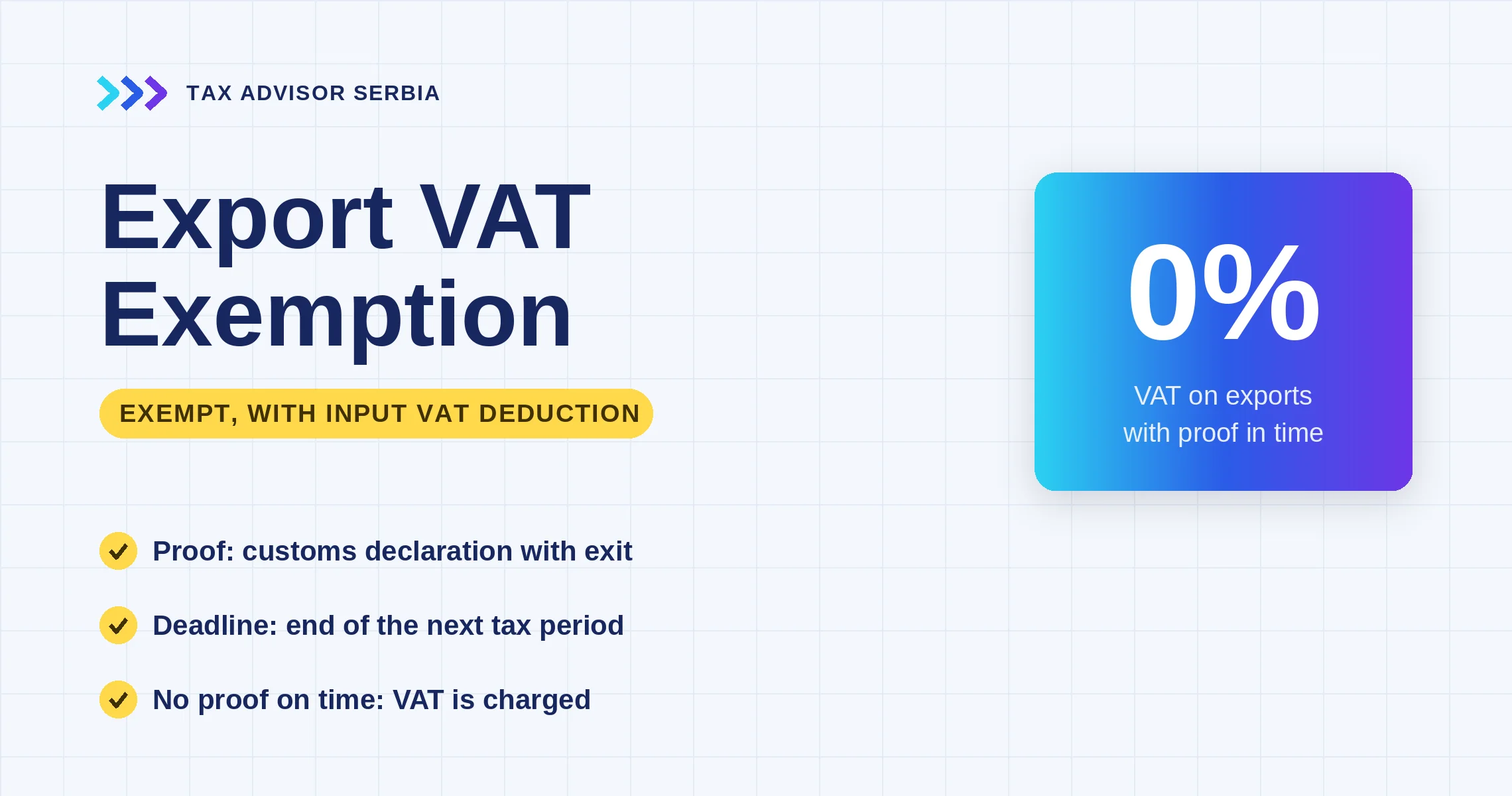
Short answer: Exporting goods from Serbia offers a significant VAT advantage. Exports are exempt with full right to deduct input VAT. But this benefit comes with strict conditions. Miss the documentation deadline or lack proper proof, and your zero-rate export suddenly becomes a fully taxable supply.
This guide explains how the VAT export exemption works in practice: what qualifies as export, required proof, critical deadlines, and how to handle common complications.
Exporting from Serbia? I answer your specific VAT question on exports in writing. I do not act as a VAT representative. Send me your question and I reply with a fixed-fee quote within 2 hours.
What Qualifies as Export of Goods?
For VAT purposes, export means a Serbian VAT taxpayer dispatches goods that permanently leave Serbian territory. The goods physically exit the country, whether directly from your warehouse, a production facility, or a customs distribution center.
Unlike imports where VAT is paid at customs entry, exports are VAT-exempt provided all statutory conditions are met. This exemption includes the right to deduct input VAT on purchases related to those exports.
Conditions for the VAT Exemption
Four conditions must be satisfied to apply the export exemption:
- The supplier must be a registered Serbian VAT taxpayer.
- The goods must physically leave Serbian territory.
- The taxpayer must hold proof of export, typically the export customs declaration (JCI/SAD) with exit confirmation.
- Proof must be obtained by the end of the tax period following the dispatch of goods.
If any condition is missing, the exemption cannot apply. The supply is treated as taxable, and VAT must be charged and reported.
Proof of Export: The Critical Document
The primary proof is the export customs declaration (JCI/SAD) issued by the Customs Administration. Crucially, the declaration must contain exit confirmation: evidence that goods actually left Serbia.
Without exit confirmation, the exemption does not apply. It doesn't matter if you've issued an invoice or received payment. No exit confirmation means no exemption.
Electronic vs Paper Declarations
Most export declarations are filed electronically through the e-customs (NAP) system using a qualified electronic signature. The Customs Administration digitally endorses the document, and exit is recorded automatically with date, time, and customs office code. This electronic document has full legal effect and serves as valid proof for the exemption.
Where paper declarations are exceptionally filed, proof consists of the JCI/SAD copy bearing the customs office endorsement in box B, stamped and signed by the customs officer.
The Documentation Deadline
Timing is everything. Proof of export must be obtained by the end of the tax period following dispatch.
For example, for a monthly VAT filer, goods dispatched in February need the exit confirmed by customs by the end of March. If exit is confirmed only in April, VAT must be calculated for February. Once you hold the export declaration, you reduce the tax base and the VAT in the return for the period in which you obtained it. The exemption is not lost, but the VAT comes first and the reduction later, which creates administrative work and a cash flow cost.

POPDV Reporting: Timely Proof, Late Proof and Advances
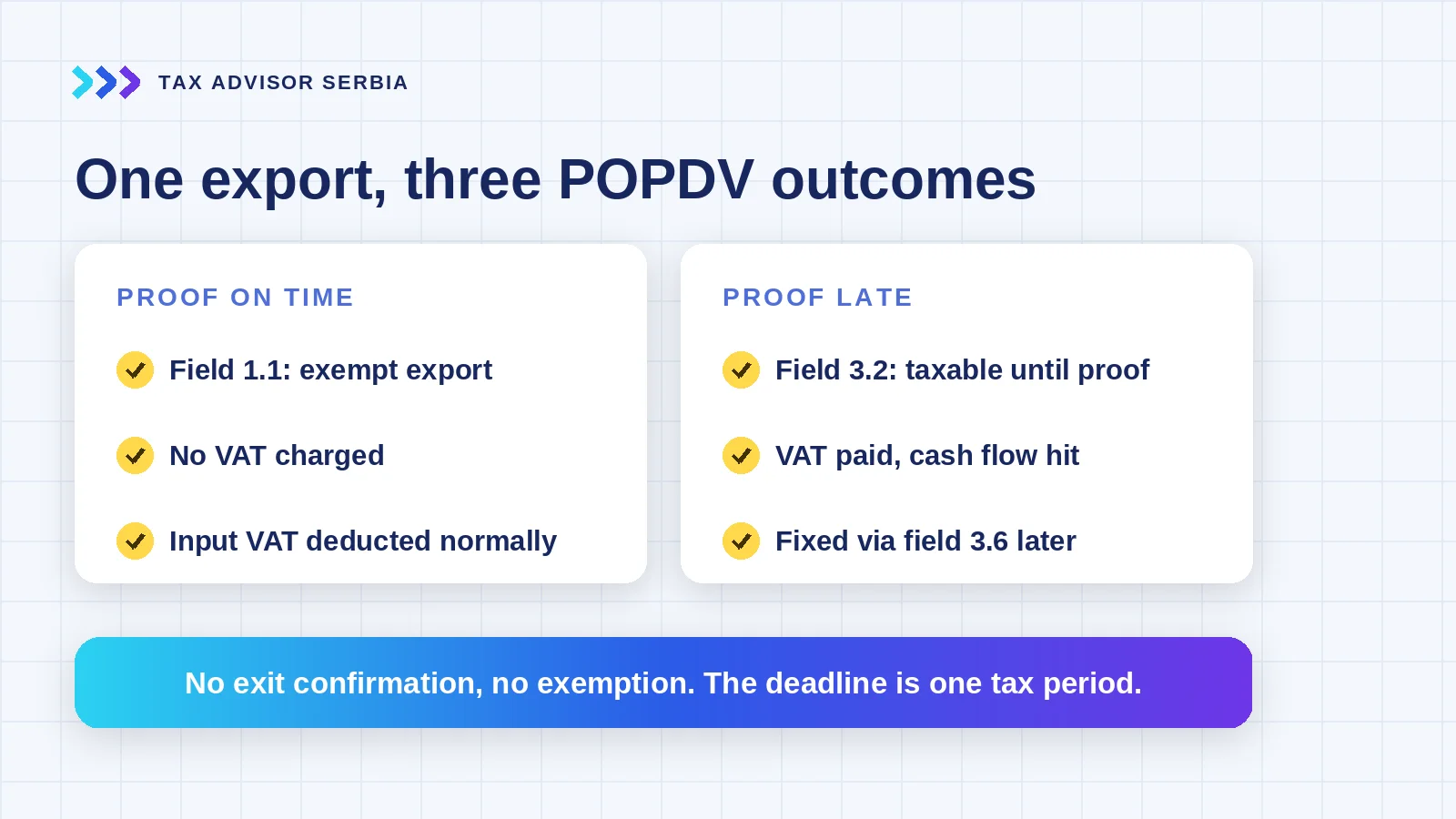
If you obtain export proof within the prescribed deadline, no VAT is charged, and you claim your input VAT deductions normally.
If proof isn't available by the end of the next tax period, you must report the supply as taxable and pay VAT on that amount. When proof is finally obtained, you correct the VAT liability and recover the VAT paid, but the process creates unnecessary work and temporary cash flow impact.
Advances create a common complication. If you receive payment before goods leave Serbia, the advance must be invoiced with VAT; the exemption doesn't apply until export actually occurs.
Which fields of the VAT return and which exchange rate apply to your export? I answer your specific VAT question on exports in writing. I do not act as a VAT representative. Send me your question and I reply with a fixed-fee quote within 2 hours.
Special Situations and Alternative Proofs
Simplified Procedures
Where export occurs without a standard export declaration, proof can be the Certificate of Performed Export (Form P-II) issued by the competent customs office. This certificate has the same evidentiary value as an export declaration with exit confirmation.
Express Courier and Postal Shipments
For shipments via post, DHL, FedEx and other express operators, proof of export is a customs certificate for such consignments. The certificate must contain at minimum: consignor, consignee, description and quantity of goods, value, and date and place of handover.
Free-of-Charge Deliveries and Donations
Exports without payment (samples, donations, promotional goods) can still be exempt if proof of export exists. They're reported separately in the return but retain the right to input VAT deduction.
Goods Destroyed During Transport
If exit is confirmed before goods are damaged or destroyed, no VAT is due. The exemption applies based on confirmed export, regardless of what happens afterward. Compensation received from carriers or insurers is not consideration for a taxable supply.
Goods Remaining in Serbia for Processing
If a foreign buyer purchases goods but they remain in Serbia (for example, for further processing), the exemption cannot apply until the goods physically leave. Only upon actual export with proper proof can the exemption be recorded.
Installation and Assembly Abroad
When goods are exported and installed or assembled at the foreign destination, the goods component is exempt as export. The installation or assembly work is treated as a service performed outside Serbia, also outside Serbian VAT scope.
Export from Customs Warehouse
Goods held in a customs warehouse that are subsequently exported qualify for exemption, provided there's an export declaration with exit confirmation. Transit through Serbia without release to free circulation doesn't trigger VAT obligations.
Intermediaries and Joint Exports
When export occurs through an intermediary, the exemption applies to whoever holds the proof of export. In joint export arrangements, the exemption belongs to the owner of goods at the time of export. Other participants in the chain invoice each other with VAT under normal domestic rules.
Compliance Checklist
Verify who is listed as exporter on the JCI/SAD; this determines who can claim the exemption.
Track dispatch dates and exit dates to monitor deadline compliance.
Archive electronic copies of declarations and P-II certificates for the statutory retention period.
Reconcile POPDV fields 1.1, 3.2, and 3.6 each period to ensure consistency.
Never apply the exemption without exit confirmation within the deadline.
How Tax Advisor Serbia Can Help
Export VAT compliance requires coordinating documentation flows, monitoring deadlines, and correctly handling exceptions. I help exporting companies by reviewing JCI/SAD and P-II documentation, aligning POPDV treatment across fields 1.1, 3.2, and 3.6, and establishing controls so exemptions are applied correctly and on time.
If you're exporting from Serbia and want to ensure your VAT treatment is correct, book a consultation or email to review your processes. See my VAT services or send me a message.
15 minutes to understand your situation and needs, so I can send you a fixed-fee quote. No tax advice is given on this call.
You may also want to read my article VAT Registration in Serbia: 2026 Guide for Businesses, or learn more About me and view my Pricing.
Sources
- Law on Value Added Tax (Zakon o porezu na dodatu vrednost), Article 24. Consolidated text, Legal Information System of the Republic of Serbia, in Serbian.
- Rulebook on Value Added Tax (Pravilnik o porezu na dodatu vrednost), Article 80. Consolidated text, Legal Information System of the Republic of Serbia, in Serbian.
Get a fixed-fee quote within 2 hours